While my research recently has focused on James Fitzjames, Graham Gore is another of Franklin’s officers whose story has been obscured. There are some parallels between the two men. It is often said that aristocratic privilege played a great part in the selection of officers for the Franklin Expedition, yet Gore’s father seems to have been illegitimate and to have started his career in the merchant marine rather than as a 'young gentleman Volunteer'.
The story starts with Graham Gore’s grandfather John Gore. John Gore was born in America, possibly Virginia, in 1729 or 1730(1). John Gore senior entered the Royal Navy in 1755 and in 1764 had sailed around the world in HMS Dolphin(2). In 1766, he sailed again in the Dolphin to "discover" the island of Tahiti. With this experience he was naturally selected by Captain Cook as one of his two Lieutenants on HMS Endeavour(3) for his famous first voyage to Tahiti in 1768 to observe the transit of Venus. During this voyage Gore senior become friends with Joseph Banks the scientist. In 1772, while on half pay, Gore senior and Banks had made a private scientific expedition to Iceland together(4).
This private expedition to Iceland prevented Gore senior from serving on Cook’s second expedition, but in 1776 he sailed again with Cook on Cook’s third and final expedition, as First Lieutenant of HMS Resolution(5). The expedition's secret instructions were to trace the west coast of the North American continent northwards as part of the search for the North-West passage. After exploring the Bering Straits, Cook returned to the Pacific and was killed at Hawaii. On his death Captain Clerke took command of HMS Resolution and Gore senior transferred to command HMS Discovery. On Clerke’s death in turn from TB on 22nd August 1779, Gore senior transferred back again to HMS Resolution and took command of the entire expedition. Thus Graham Gore’s grandfather actually ended his sea-going career as commander of Cook’s Third Expedition.
On his final return to England Gore senior retired as a Captain of Greenwich Hospital, where he lived in the rooms Cook had occupied. He died there in 1790 at the age of sixty.
John Gore senior’s son was also called John. This John Gore was born on 7th March, 1774. Cliff Thornton of the Captain Cook Society has confirmed that he was born at Barking in Essex (other genealogical researchers had transcribed this as 'Boking') although the Royal Navy records his place of birth as London(6). There seem to be well-seated doubts as to whether this son’s birth was legitimate or not. When Gore senior sailed again he placed the two year old boy in the care of the Rev. Firebrace of Braintree in Essex with Sir Joseph Banks acting as his guardian(7).
John Gore first went to sea at the age of eleven, in 1785. This was not service in the Royal Navy, but a commercial venture arranged by a friend of his father called Nathanial Portlock. Portlock had served on Cook’s third voyage of exploration as an Able Bodied seaman on HMS Discovery, although he was soon appointed master's mate. Portlock’s 1785 voyage in the ‘King George’ and the ‘Queen Charlotte’ was a fur-trading venture to the American north-west coast which returned to England in 1787(8) having twice over-wintered twice in Hawaii and traded at Macao before returning home round the world(9).
Thus it was that when John Gore first entered the Royal Navy on HMS Guardian in 1789 at the age of fifteen he had already sailed around the world. O'Byrne's Naval Directory states that he was entered as an Able Bodied Seaman(10) but Cliff Thornton of the Captain Cook Society has told me that the Muster Book for HMS Guardian, (ADM36/11005) shows that he was entered as a Midshipman. HMS Guardian was commanded by Lieutenant Edward Riou, another former shipmate of John Gore senior who had served on Cooke’s third expedition – Riou had been a Midshipman on HMS Discovery(11).
The Guardian was Riou’s first command. HMS Guardian was a Royal Navy frigate which had been converted into a transport and was engaged in a vital task – bringing vitally needed supplies from England to the struggling penal colony which Britain had established in 1788 at Sydney Cover, New South Wales(12). The story of the ‘First Fleet’, which established British settlement in Australia is well known. The Guardian sailed from Spithead on 2nd September 1789 loaded with over a thousand tons of supplies, including a ‘garden’ of plants and seedlings selected by Sir Joseph Banks as being of use to the newly established colony on the other side of the world and livestock. On Christmas Eve, 24th December, 1789, HMS Guardian was off Marion Island, 1,300 miles from the Cape of Good Hope and short of fresh water when the lookout spotted an iceberg. Riou decided to pick up ice to replenish his fresh water tanks, which were being depleted at an alarming rate not just by his crew but also by the plants and livestock he was trying to keep alive. Despite towering seas and terrible weather conditions, the ship’s jolly boat was launched to collect ice from the berg. While it was doing so the Guardian collided violently with the iceberg, losing her rudder and being holed below the water-line. Riou seems to have had great difficulty controlling his crew and the convicts under these desperate conditions and on the following day, Christmas Day, gave an ‘every man for himself’ order. Some of the crew left in five ships’ boats. Only one, with fourteen survivors, was ever seen again. Some drunken men and convicts simply jumped into the sea, so imminent did it seem that the Guardian would sink. ‘I am inclined to think’ Riou wrote ‘they could but have survived a few minutes’. Riou was the only commissioned officer. John Gore was among the men who stayed with Riou and helped him eventually bring the stricken Guardian back to the Cape. During the voyage Gore seems to have been promoted to Master’s Mate. Under these dire circumstances ability and leadership counted for more than accident of birth. Although this epic story of survival has since been all but forgotten, it created a sensation at the time(13).
O’Byrne’s Directory says that he was next ‘attached, from July 1791, until September 1793, to the Assistant armed tender, Lieut-Commander Nathaniel Portlock ... engaged, in company with HMS Providence, in carrying the bread-fruit plant to the West Indies’. HMS Providence was captained by William Bligh and the Assistant was her escort. Bligh had already returned from the Pacific following the mutiny on HMS Bounty in 1787. The voyage of the Providence and the Assistant in August 1791 was to complete his original mission. The ships sailed for the Pacific and successfully conveyed breadfruit to the West Indies, returning to England in February 1794. I am grateful again to Cliff Thornton of the Captain Cook Society for clarifying this. [Incidentally, I live just down the road from Captain Blight's London town house which externally is unchanged since he lived in it. I think about the interplay between past and present whenever I pass it on the 159 bus.]
After this service he was entered into HMS Namur on 31st March, 1795 and promoted to Lieutenant only five months later on 19th August 1795. From then he served more or less continuous on a succession of ships until coming ashore from HMS Marlborough at the age of thirty-four on 20th September, 1808(14), newly promoted to the rank of Commander. His service was distinguished. Under Captain Moore of the Indefatigable, he was strongly commended for bravery during the capture of three Spanish frigates laden with treasure and the destruction of a fourth off Cape St. Mary on 5th Oct, 1804(15).
While First Lieutenant of HMS Fame, Gore had married Sarah Gilmour at Portsmouth on 15th May, 1806. She was from Alverstoke in Southampton. The couple had six children who survived into adult-hood. The eldest was a boy, inevitably named John, who was born in 1807 and followed by a younger brother Graham, born in 1808 or 1809. After these two there were three daughters Anne, Charlotte and Eliza and a further son, Edward, who was born in 1817. Evidence suggests the family settled in the Plymouth area. Graham’s Royal Naval records give his place of birth as Plymouth(16) and a letter from John Gore to the Admiralty says of Graham, aged eleven, that he had been “educated by myself and Mr. Bridge, Schoolmaster of Barnstaple”(17). When not in London or at sea, Gore wrote from an address at Bickington which was then a small village only two miles from Barnstaple, so this evidence is all consistent. It seems therefore that Gore was at home on half pay partly to educate his family and help his wife Sarah bring up the family.
Gore certainly attempted to gain further seagoing appointments(18) but only went to sea again once as Captain of the sloop HMS Dotterel from 12th February 1818 until 20th July, 1821. The first voyage of the Dotterel under Gore was part of the resupply convoy for the British garrison at St. Helena. St. Helena was hard pressed to support the large establishment which was guarding Napoleon, exiled for life there. It must be presumed therefore that John Gore had the opportunity then of meeting the exiled former Emperor. Another officer who must have made the acquaintance of Napoleon was a twenty two year old Irishman serving as a Mate on the Dotterel: Francis Crozier(19). After this voyage the Dotterel settled down to a relatively quiet routine of patrols in the Irish Sea and the coastal waters of Britain. Gore was presumably able to stay in touch with his family during this time. Crozier seems to have become bored with this promotion dead-end and volunteered for Arctic duty. Perhaps he was inspired to do so by hearing his Captain’s retelling of the stories of his youth in the Southern Ocean and the far northern Pacific, and of Cook's attempts to enter the North West Passage? Either way, Crozier was accepted by Edward Parry and was discharged from HMS Dotterel on 13th February, 1821 before the Dotterel’s commission ended. He joined HMS Fury, the bomb-ship specially converted for Arctic exploration. This was Crozier’s first step towards his ultimate death on the Franklin Expedition more than twenty-five years later.
Crozier was not the only member of the Dotterel’s company to die on the Franklin Expedition. We have seen that Gore had taken at least partial responsibility for the education of his family. On 24th November, 1819, he had entered his elder son John onto HMS Dotterel. The records suggest that the thirteen year old John may have first been entered as an Able Bodied seaman and then transferred to the rank of Midshipman as a Volunteer of the first class. Perhaps this was done to enable John Gore to take the lad to sea without having to obtain Admiralty authority to enter him as a Volunteer? One of the responsibilities of a Captain in relation to his ‘young gentleman Volunteers’ was to supervise their education so, although life for all members of the early nineteenth century Royal Navy was tough, this position was a natural one for Gore to arrange to continue his family’s education. At the end of the Dotterel’s commission on 20th July, 1821, Gore senior was promoted to Captain and arranged for his son John to attend the Royal Naval College, then at Portsmouth, where John passed out with a prize for mathematics(20).
The sloop had a complement of three Volunteers of the First Class(21). At the beginning of 1820, Gore had a vacancy for one. He wrote to the Admiralty from his anchorage at Cork on 2nd January, 1820, to say that ‘being a vacancy in the sloop I command for a volunteer of the first class boys, I have to request you will be pleased to move their Lordships to permit me to enter Mr. George Rawe Hallett, aged 15 years (son of Mr. John Hallett, surgeon of the Royal Navy) who has been educated by Mr. Godber of Fowey’(22). Permission was granted, but George Hallett was taken ill so Gore wrote again on 26th April 1820 ‘to permit me to enter my son Graham Gore, age 11 years, educated by myself and Mr. Bridge, Schoolmaster of Barnstaple’(23). The Admiralty had doubts about permitting such a young boy to be entered, but granted permission on 28th April, which was just as well as his father had already entered Graham on the books of his ship on the previous day(24).
Thus the three Gores, father and two sons, served together with Francis Crozier and the rest of the Dotterel’s company for nearly a year until Crozier’s appointment to the Fury. The three Gores remained aboard the ship until she paid off on 20th July, 1821. Graham seems to have lived at home for a further year, presumably with his now promoted father continuing his education, until he followed his elder brother to the Royal Naval College in 1822. John Gore senior, despite petitioning the Admiralty, never went to sea again and his eldest son John, having reached the rank of Lieutenant, was later drowned at sea.
Graham Gore next went to sea as a Midshipman on 10th April, 1824 and served until 31st August 1828 successively on HMS Ocean, HMS Albion and HMS Mosquito(25). On HMS Albion he fought in what was to prove to be the last ever battle between Nelson-era wooden sailing ships, the Battle of Navarino on 20th October, 1827. He passed for Lieutenant in 1829.
He made a hair-raising voyage to the Arctic from June 1836 to August 1837 as Mate on HMS Terror under the command of Captain Sir George Back. The Terror was badly damaged in this attempt to reach Repulse Bay, where it had been hoped to land a party to explore the Arctic coast of North America. The ship only just made it back across the Atlantic and had to be beached at the first land it reached in western Ireland. Such was the damage that the Terror was only held together by chains passed around the hull.
Graham Gore was then promoted to Lieutenant and entered HMS Modeste on 22nd November, 1837, followed by HMS Volage. On the Volage he took part in fighting in the first Anglo Chinese, or Opium War.
While in India he was posted to HMS Herald in Australia. But arriving in Sydney, Gore could not locate the Herald. Instead he found the famous HMS Beagle, of Darwin fame and volunteered to join her. He sailed on the Beagle from November 1840 until October 1843 under Captain John Lort Stokes on her famous third voyage, during which large parts of the Australian coast were accurately surveyed for the first time. It was during this voyage that the city of Darwin was named. Gore was a talented artist and served as unofficial artist on this voyage. One of his paintings hangs today in the National Library of Australia, depicting Burial Reach on the Flinders River in Queensland. Bizarrely, the Flinders River was named after Captain Matthew Flinders, who had been accompanied on some of his voyages of discovery in Australian waters by one Midshipman John Franklin.
Graham Gore narrowly escaped death at a place the Expedition subsequently named ‘Disaster Inlet’. He was shooting Cockatoos for food from a gig, in the company of Captain Stokes and some sailors. The mangrove trees in the inlet were ‘literally whitened with flocks of noisy cockatoos, giving the trees an appearance as if they were absolutely laden with huge flakes of snow—a somewhat remarkable aspect for a scene in such a clime to wear’, according to Stokes, who continued ‘soon the huge masses of white plumage began to float from tree to tree across the reach, whilst their screams as they flew by seemed a fair challenge to the sportsman. Mr. Gore accordingly resolved to secure a few of them for dinner, and put out his gun for the purpose’. When Gore fired, ‘ere the report of the gun had ceased to roll over the waters of the reach ... something whizzed past my ear, deafening and stupefying me for a moment--the next I saw my much-valued friend Gore stretched at his length in the bottom of the boat’. Gore’s gun had burst, leaving only a small portion of the barrel which fell back into the gig. Gore's hand was lacerated but he suffered no worse injury. According to Stokes, Gore himself broke the shocked silence with the immortal words ‘killed the bird...’ which Stokes described as ‘an expression truly characteristic of a sportsman’(26).
When the Beagle’s commission ended, he was entered onto the steamer Cyclops before arriving back in England in time for his next, and last, appointment to the Franklin Expedition in 1845. Sadly, that sealed his fate.
We can now see that his links with the Franklin Expedition were far deeper than hitherto have been understood. His grandfather had been a close associate of Sir Joseph Banks, who acted as the eminence grise to a whole series of British scientific expeditions. He himself had served with Crozier on the Dotterel. He had served under Stokes on the Beagle, and Stokes was a candidate the Admiralty considered to command the Expedition if Franklin declined it or had been declared unfit. It also transpires that Graham Gore’s father had a link with Fitzjames although that must remain under wraps until the publication of ‘James Fitzjames, the Mystery Man of the Franklin Expedition’. Lastly, the Gores can be seen to be much less of an ‘establishment’ family than is supposed. Technically speaking, both Graham and his father seem to have gone to sea first as sailors rather than as 'young gentleman Volunteers' and the senior Gore seems to have been illegitimate.
So what happened to Graham Gore’s family? With his eldest son dead and Graham at sea, at the age of sixty John Gore emigrated to New South Wales in 1834 with his wife Sarah, their three daughters Ann, Eliza and Charlotte and youngest son Edward on board 'City of Edinburgh'(27). The family first lived at Parramatta, then a small farming settlement near Sydney. Later they acquired 1,165 acres of land near Lake Bathurst in southern New South Wales where they settled in a house which they named 'Gilmour'. John Gore lived to know that he had been promoted by rote to Rear Admiral in 1852 and died in 1853(28). Sadly, before he died he would also have realised that his second son Graham would not be coming back from the Arctic. We now know from the Victory Point note that Graham Gore died sometime between June 1847 and April 1848 in the ice off King William Island. It is ironic that ice, the ultimate cause of his death, had almost caused the death of his father over half a century earlier in the great Southern Ocean.
Descendants of John Gore, and therefore relatives of Graham Gore, live to this day in Australia. While two of Graham Gore’s sisters, Ann and Charlotte, died unmarried, his sister Eliza married George Stewart in 1839 and had seven children and his brother Edward married Eliza Strang, who had two sons and a daughter. At least one descendant fought in the First World War, the appropriately named Private Rupert Franklin Gore Gallaway of the Australian 2nd Light Horse Regiment.
References
(1) http://www.captaincooksociety.com/ccsu41126.htm#REF1
(2) http://www.captaincooksociety.com/ccsu41126.htm#REF1
(3) http://www.captaincooksociety.com/ccsu70.htm
(4) http://www.captaincooksociety.com/ccsu41126.htm#REF1
(5) http://www.captaincooksociety.com/ccsu70.htm
(6) ADM 37/1208 says he was born in London
(7) http://www.captaincooksociety.com/ccsu41142.htm
(8)
http://content.wisconsinhistory.org/cdm4/document.php?%289%29CISOROOT=/aj&CISOPTR=11778(9) http://www.swmaritime.org.uk/forums/thread.php?threadid=1199
(10) O’Byrne, William - Naval Biography 2 vols. 1848.
(11) http://www.captaincooksociety.com/ccsu70.htm
(12) http://www.angelfire.com/trek/guardian/
(13) http://botanybaymedallion.com/?page_id=81
(14) ADM196/4
(15) London Gazette, 1804, p1310
(16) ADM107/74
(17) ADM1/1864, Letter Cap G53
(18) ADM1/1864, Letter Cap G25
(19) ADM37/6204
(20) ADM1/1864, Letter CapG53. In this letter John Gore writes from Barnstaple to say that ‘being apprised by the Lieutenant Governor of the Royal Naval College that a medal has been awarded to my son Mr. John Gore as the second best student that was discharged during the last half year, and that I should apply to the Lords Commissioners of the Admiralty for the same - I have therefore to request that you will be pleased to move their Lordships to cause the same to be forwarded to me’. This was refused. A dismissive note on the letter says that it should ‘delivered to any one who calls for it’.
(21) http://www.pbenyon.plus.com/Navy_List_1835/Young_Gentlemen.html
(22) ADM1/1864, Letter CapG17
(23) ADM1/1864, Letter CapG31
(24) ADM37/6204
(25) ADM107/74
(26) Discoveries in Australia, with an Account of the Coasts and Rivers Explored and Surveyed ...’ Volume 2, Stokes, John Lort.
(27) Information from Janet Syme, ibid
(28) http://newsarch.rootsweb.com/th/read/GORE/1998-08/0902767406

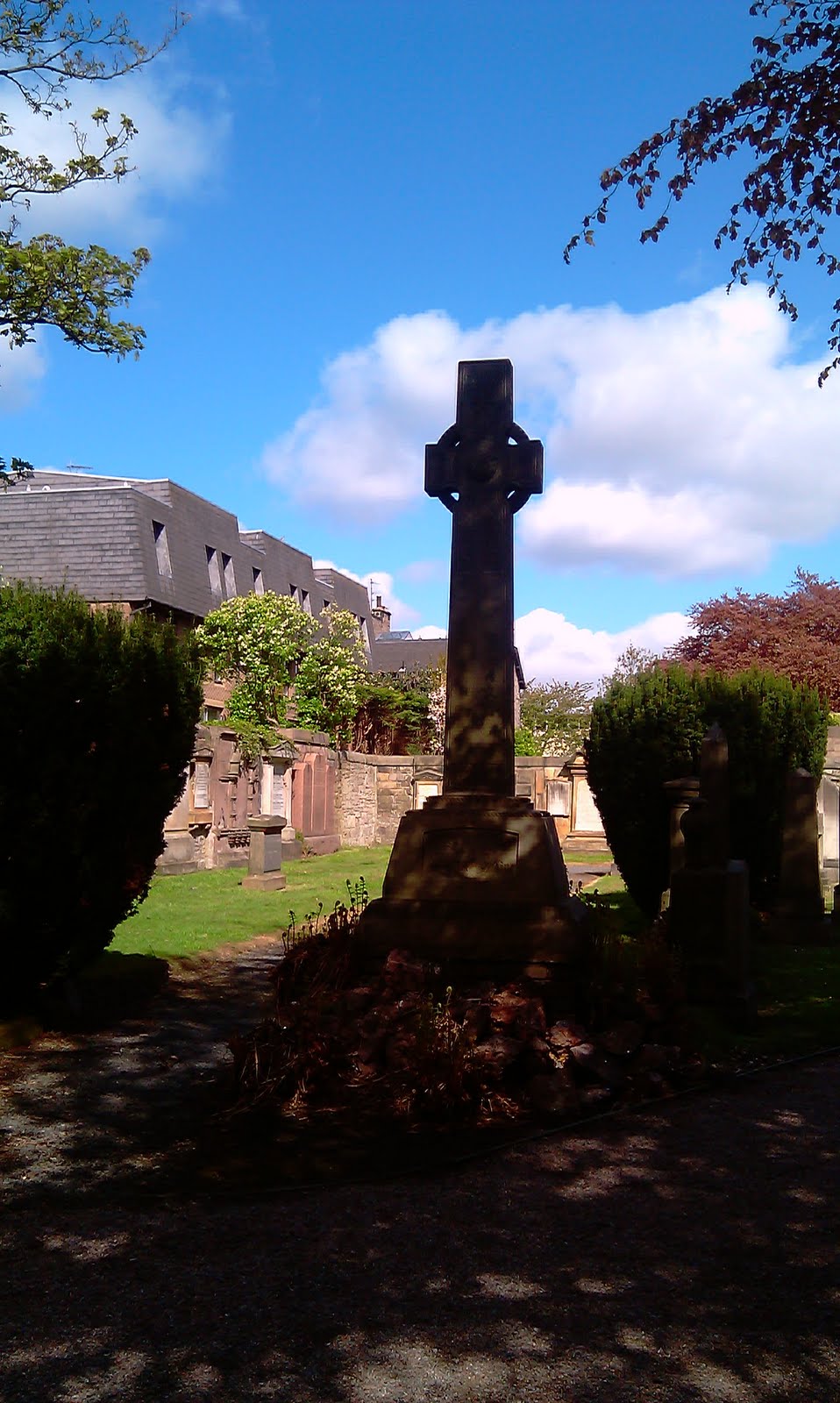 Yesterday I was able to visit the Edinburgh tomb of Lt. John Irving, RN, of the Franklin Expedition. As many people will be aware this tomb contains the remains of an officer of the Franklin Expedition buried on King William Island, which were discovered by Lt. Schwatka. On the basis of a medal found associated with the grave, the remains were identified as those of Lt Irving.


