Just a note that I was interviewed this morning by Erin Knight of Open Book: Toronto about my book 'James Fitzjames: The Mystery Man of the Franklin Expedition'.
You can find my interview at the Open Book: Toronto website here. It's also noted in the section listing all the reviews on the book's website at www.jamesfitzjames.net
Showing posts with label Franklin Expedition. Show all posts
Showing posts with label Franklin Expedition. Show all posts
Wednesday, 6 October 2010


Wednesday, 29 September 2010
Sir James Gambier

Until 'James Fitzjames: The Mystery Man of the Franklin Expedition' was published, there was no public knowledge of who James Fitzjames' true father was - in fact it was a closely guarded secret.
The book presents the evidence that his father was a British diplomat of the early ninteenth century called Sir James Gambier. Publication of the book put me in touch with (legitimate) descendants of Sir James, and through them I was able to see a portrait of Sir James, which they have kept down the generations and still retain.
Here is a photograph I took of the portrait.
There is more information and a close-up of Sir James' face on the book's website here.
Can anyone spot a resemblance between Sir James and his ill-fated son, James Fitzjames, in the Franklin Expedition Daguerreotypes?
Sunday, 12 September 2010
Early news of an exciting possible new discovery of Franklin Expedition remains
A potentially very interesting new piece of evidence has emerged today for those trying to piece together 'the Fate of Franklin' from the Future Capital Partners North West Passage Expedition, led by Bear Grylls. (http://www.fcpnorthwestpassage.com/). This was a voyage by Bear Grylls and six companions through the North West Passage this summer in an open Rigid Inflatable Boat, the "Arctic Wolf". Do read their description of their exciting transit of the North West Passage and the exciting discovery they have made.
On their way south down Peel Inlet and Franklin Strait from Resolute Bay, heading towards King William Island, the team took shelter in the lee of an island 'abutting the Wellington Straight in the uncharted waters off the coast of King William Island'. It is only about 8 meters high and 200 metres across. They named it Jonesy Island after their marine engineer Ben Jones. Ben has discovered evidence that an earlier group of people spend some time, and died, at this desolate spot. The evidence so far described is:
Now let us shamelessly speculate what this find might mean IF it turns out to be of Franklin Expedition members. It might represent the final resting place of a group of refugees struggling north east back the way they had come, perhaps hoping that their first anchorage at Beechey Island would by then have been discovered.
There is another possibility. In an earlier post I suggested that the conventional interpretation of the Victory Point note may be wrong, and that in the autumn of 1845 the Expedition might instead have secured the ships at Beechey Island and spent the following months until they sailed in 1846 exploring the waterways to the west, south and north to seek out the best passage to follow. I speculated that they first attempted to break through north via Wellington Straight, before doubling back to Peel Inlet via the west of Cornwallis Island. If this did in fact take place, then this site might be where a, or perhaps the, party exploring south met its end. Perhaps it was the loss of this party which tipped the balance in the minds of the Expedition's leaders that they should attempt the northern route rather than the southern?
This is of course completely speculative, but it may be an example of how much more still remains to be found of the Franklin Expedition in the Arctic. It will be fascinating to see what evidence the Future Capital Partners North West Passage Expedition has been able to bring back and what the final interpretation of this exciting discovery will be.
On their way south down Peel Inlet and Franklin Strait from Resolute Bay, heading towards King William Island, the team took shelter in the lee of an island 'abutting the Wellington Straight in the uncharted waters off the coast of King William Island'. It is only about 8 meters high and 200 metres across. They named it Jonesy Island after their marine engineer Ben Jones. Ben has discovered evidence that an earlier group of people spend some time, and died, at this desolate spot. The evidence so far described is:
- Signs of large fires having been lit on the northern side of the island abutting Wellington Straight. Because of the direction of the prevailing winds, they interpret these as beacons lit by men hoping for rescue from the North, rather than for warmth. They make the point that to burn so much wood is characteristic more of desperate westerners rather than Inuit.
- What appears to be part of a mast blown up on shore. Presumably from a ship's boat rather than the mainmast of a ship, but that will have to wait for clarification.
- Whale-bone pins. Given that the Franklin Expedition was well equipped with metal needles, which were found in some quantity at their Felix Cape encampment, this is perhaps more suggestive of an Inuit presence.
- Human remains buried in 'western looking graves'. Associated with these were bones and a small piece of felt or fabric – certainly not indicative of an Inuit burial. How many individuals are represented is not entirely clear – certainly more than four – and Bear Grylls also located a human skull not associated with any grave.
- What appear to be tent-circles made from stones.
Now let us shamelessly speculate what this find might mean IF it turns out to be of Franklin Expedition members. It might represent the final resting place of a group of refugees struggling north east back the way they had come, perhaps hoping that their first anchorage at Beechey Island would by then have been discovered.
There is another possibility. In an earlier post I suggested that the conventional interpretation of the Victory Point note may be wrong, and that in the autumn of 1845 the Expedition might instead have secured the ships at Beechey Island and spent the following months until they sailed in 1846 exploring the waterways to the west, south and north to seek out the best passage to follow. I speculated that they first attempted to break through north via Wellington Straight, before doubling back to Peel Inlet via the west of Cornwallis Island. If this did in fact take place, then this site might be where a, or perhaps the, party exploring south met its end. Perhaps it was the loss of this party which tipped the balance in the minds of the Expedition's leaders that they should attempt the northern route rather than the southern?
This is of course completely speculative, but it may be an example of how much more still remains to be found of the Franklin Expedition in the Arctic. It will be fascinating to see what evidence the Future Capital Partners North West Passage Expedition has been able to bring back and what the final interpretation of this exciting discovery will be.
Saturday, 11 September 2010
Updates, Corrections and Reviews
Much of the content of 'James Fitzjames: The Mystery Man of the Franklin Expedition' was researched by me from primary sources. Inevitably in doing this there were some errors which I made. Also, the process of publication spreads the net of my research much wider, so more and more people with complementary knowledge will be able to add to mine.
I will therefore be maintaining a section on the book's website here so that as I receive this information I can maintain in one place a complete list of all the revisions I would wish to make to the book.
If you have a look now you will see there are three updates - all quite interesting. The most exciting is that I am now aware of the existence of a portrait of Sir James Gambier, James Fitzjames' true father. I am hoping to be given permission to place a detail of this on the internet. And yes, there is a strong family resemblence.
I have also added a section to the website providing links to reviews of the book. So far I have linked to 'The Arctic Book Review' and 'Macleans'. Maybe there will be more? If you see a review I have missed, please drop me a line so I can add it.
I will therefore be maintaining a section on the book's website here so that as I receive this information I can maintain in one place a complete list of all the revisions I would wish to make to the book.
If you have a look now you will see there are three updates - all quite interesting. The most exciting is that I am now aware of the existence of a portrait of Sir James Gambier, James Fitzjames' true father. I am hoping to be given permission to place a detail of this on the internet. And yes, there is a strong family resemblence.
I have also added a section to the website providing links to reviews of the book. So far I have linked to 'The Arctic Book Review' and 'Macleans'. Maybe there will be more? If you see a review I have missed, please drop me a line so I can add it.
Tuesday, 10 August 2010
The Arctic Book Review reviews 'James Fitzjames'
Professor Russell Potter (why am I always tempted to describe Russell as 'the indefatigable'?) has just beaten off the rest of the world's literary establishment to publish the first review of my book 'James Fitzjames: The Mystery Man of the Franklin Expedition'.
You can read it here:
http://arcticbookreview.blogspot.com/2010/08/james-fitzjames-mystery-man.html
Thanks, Russell!
You can read it here:
http://arcticbookreview.blogspot.com/2010/08/james-fitzjames-mystery-man.html
Thanks, Russell!
Sunday, 8 August 2010
William (well, James Fitzjames really) hits the airwaves
I'm grateful to Howard Leader of BBC Radio Lincolnshire for having taken the trouble to read my book 'James Fitzjames: The Mystery Man of the Franklin Expedition' and then to discuss it with me live on his BBC radio programme today. Howard's programme is on the BBC website for another seven days and if you want to listen to it the link is at:
http://www.bbc.co.uk/iplayer/episode/p00956y9/Howard_Leader_08_08_2010/
Howard's chat with me begins 1:13:45 in to the broadcast.
Howard broadcasts a weekly programme on Sunday afternoons on BBC Radio Lincolnshire from 3:00 pm to 6:00 pm which is a mix of nostalgia, music from the '40's and '50's and interviews with special guests. Well, this afternoon I was his special guest. He asked me a series of informed and sensitive questions about James Fitzjames and the Franklin Expedition. This was my first radio interview and Howard was great - he made me feel quite relaxed.
It's been quite a big day for me and of course I'm pleased to have the exposure. It might sell a few more books. But for me Howard's interview has a much deeper significance. That's because I didn't write this book for me. I know this may sound ridiculous, but what compelled me to write about the Franklin Expedition and about James Fitzjames was a gut feeling that posterity has dealt the men of the Expedition, and Fitzjames in particular, a poor hand. Having read so many of their letters and the records relating to them, I now understand that these men were neither insensitive Imperialists on the one hand, nor selfless heroes on the other. Instead they were real people who set out to do an outlandish thing - to sail the Erebus and Terror through those ice-choked waterways. They failed, but if their guts could inspire and earn the respect of a man like Roald Amundsen, as it did, then I feel that people in their homeland and their adopted homeland Canada should respect them too.
Howard gave me an opportunity to talk in public about James Fitzjames the man, and that for me will always be a privilege.
http://www.bbc.co.uk/iplayer/episode/p00956y9/Howard_Leader_08_08_2010/
Howard's chat with me begins 1:13:45 in to the broadcast.
Howard broadcasts a weekly programme on Sunday afternoons on BBC Radio Lincolnshire from 3:00 pm to 6:00 pm which is a mix of nostalgia, music from the '40's and '50's and interviews with special guests. Well, this afternoon I was his special guest. He asked me a series of informed and sensitive questions about James Fitzjames and the Franklin Expedition. This was my first radio interview and Howard was great - he made me feel quite relaxed.
It's been quite a big day for me and of course I'm pleased to have the exposure. It might sell a few more books. But for me Howard's interview has a much deeper significance. That's because I didn't write this book for me. I know this may sound ridiculous, but what compelled me to write about the Franklin Expedition and about James Fitzjames was a gut feeling that posterity has dealt the men of the Expedition, and Fitzjames in particular, a poor hand. Having read so many of their letters and the records relating to them, I now understand that these men were neither insensitive Imperialists on the one hand, nor selfless heroes on the other. Instead they were real people who set out to do an outlandish thing - to sail the Erebus and Terror through those ice-choked waterways. They failed, but if their guts could inspire and earn the respect of a man like Roald Amundsen, as it did, then I feel that people in their homeland and their adopted homeland Canada should respect them too.
Howard gave me an opportunity to talk in public about James Fitzjames the man, and that for me will always be a privilege.
Sunday, 1 August 2010
Thinking about HMS Investigator
 The finding of HMS Investigator has made headline news across the world. What a great achievement!
The Parks Canada website has a very clear account of the find and also some wonderful pictures, at
http://www.pc.gc.ca/eng/culture/expeditions/introduction.aspx
Here, as well as a description of the campaign, the team and their plans, there are some wonderful pictures not just of the ships but of the graves and the remains of the cache of stores which McClure left on shore.
It is interesting to compare Parks Canada’s photographs with the arresting contemporary paintings of Samuel Cresswell:
http://www.spri.cam.ac.uk/museum/catalogue/polarart/artists/cresswell,+samuel+gurney/
From the perspective of the search for Franklin this relocation of HMS Investigator is almost eerily significant. The Investigator, with her companion HMS Enterprise, was the first ship to set out to try to find the Franklin Expedition in 1848 at a time when most members of that Expedition were still alive. So it was the Investigator which opened the largest and longest search and rescue effort in history – the quest to find out what happened to Franklin, his men and his ships. It is very fitting that this Parks Canada team, with the powerful modern Canadian ice-breaker Sir Wilfred Laurier, should have made this direct link with the first ship to take part in this search.
The dramatic pictures of the Investigator will serve as a welcome reminder of the remarkable achievement of her Captain, Robert McClure and his men, in being probably the first people to complete the North West Passage. (Let’s not forget that it is perfectly feasible that some Inuit peoples made this same journey earlier, but sadly memories of that epic of exploration will have been lost). And anyone who looks at the Parks Canada map must feel a chill of horror at just how remote the site of the Investigator is. How brave these men were to push themselves into such a hostile and remote part of the world. And while McClure may not have had a very good press for some of the harsh decisions he took, and contemplated, unlike Franklin he was able to bring most of his men home. It’s wrong for us today to be judgemental in the case of a man placed in such a hugely difficult position with such terrible responsibilities.
Another significant aspect of this dramatic news is the light it may help shed on the Franklin Expedition itself. The Investigator was fitted out only three years after the Erebus and Terror. It is fitted with the same Sylvester central heating system with which it now appears the Erebus and Terror were equipped – the longstanding allegation that that those ships had a steam heating system now seemingly a misconception. A scientific examination of her must surely help us better understand what may have happened to the Erebus and Terror.
Also very important is consideration of the graves of the three crewmembers of the Investigator who died at Mercy Bay. Should they be left there? The decision should be for their next of kin, who are perhaps not yet aware that their distant relatives bodies’ still lie frozen in Mercy Bay. A further decision these unknowing relatives may consider is whether to have their relatives’ bodies’ autopsied. Such an examination is intrusive, but would no doubt shed very valuable information on the disease and dietary conditions on Arctic ships of the time. Re-reading Sherard Osborne’s ‘The Discovery of the North West Passage..’ I see that the death of AB John Boyle, first man to die, was said to have been ‘occasioned by the thoughtlessness of the poor fellow himself, who, by way of a joke, went into the surgery and drank off the washings of several medicine bottles’. One wonders whether this was the whole truth. Especially since the two other men to die at Mercy Bay, AB John Eames and John Kerr, Gunner’s Mate, did so only a few days after AB Boyle.
Already there have been calls for the Investigator herself to be raised and taken back south to form the core of a museum in southern Canada. And why not? While the ship has been remarkably preserved in Mercy Bay where she lies, even there she must be vulnerable now to treasure hunters and also to further damage by large icebergs. The relocation of the Investigator is bringing to the fore decisions which will have to be faced if the Erebus or the Terror are ever discovered. In many ways, these ships are now part of the North and should remain there. But the ships may still contain the mortal remains of some of the officers and men of the Franklin Expedition, and their relatives may well feel repatriation is appropriate. Once located, the ships will be vulnerable to further degradation by Nature and by man.
So this great news should help us applaud the memory of McClure and his men, wonder at the preservation of their ship HMS Investigator and wish the very best of good fortune to those who are searching for Franklin, his ships and his men this summer.
Will there ever be an end to this story?
Friday, 9 July 2010
The book has been published...
Well, I am absolutely delighted to say that my book, 'James Fitzjames: The Mystery Man of the Franklin Expedition' has been published.
I am so grateful to Simon Hamlet, my publisher at The History Press for taking the book on. Not every publisher was willing to entertain a book by someone who had never written before. Thanks Simon! And Abbie Wood, who designed the book and has also done a great job.
It is also great news that Dundurn in Canada has taken the book on as that gives it great coverage on the left hand side of the pond.
I'm going to be fascinated by the response to it. I still feel reluctant to discuss the outcomes of my research publicly, which is rather a strange reacon given that the book describes them in great detail and is available for the world to buy. But I do feel deeply, deeply privileged that I was the person who was able to get close to this fascinating, but ultimately cursed, young man James Fitzjames. For the truth was that he was anything but the privileged young aristocrat of Franklin Expedition mythology. Heavens, he wasn't even genuinely English! He struggled and fought for the position he craved in the Royal Navy, and it is very unfair that ever after he has been held up as someone who didn't need to. And far from being the favourite of Sir John Barrow, the relationship with Barrow was much stranger than anyone ever realised.
I hope that the book has two results. The first is that I trust that people can start to look again at 'The Men who Sailed with Franklin' as men, and not as stereotypes. Just as the baddie of the story, Charles Dickens, ridiculously traduced the Inuit families who met the Franklin survivors, and even tried to help them, as 'savages', I think it is no longer fair to look at Franklin's men as stereotypical imperialists either. I believe when we analyse them we find that many were men much closer to the margins of their society than popular myth would allow. Men like Fitzjames and Gore, for example, had very peripatetic backgrounds. The second result, I hope, is that the tragedy of James Fitzjames will be recognised as a sad human story in its own right. How cruelly ironic that just as he had won the position in English society that his shameful origins had earlier denied him, and as soon as he had gained a really powerful source of patronage, he should use that to participate in the greatest disaster in British exploration history! I am sure this was an irony NOT lost on him in his last months.
Anyway, I'll be fascinated to hear your feedback to the book, which you can buy at
http://www.thehistorypress.co.uk/products/James-Fitzjames-the-Mystery-Man-of-the-Franklin-Expedition.aspx
Let me know what you think.
Incidentally I've set up a website
http://www.jamesfitzjames.net/
Which I'll be using specifically to support the book. I'll locate here any additional references which people want. Perhaps there are other things we can do.
Anyway people, over to you know - let me know what you think....
I am so grateful to Simon Hamlet, my publisher at The History Press for taking the book on. Not every publisher was willing to entertain a book by someone who had never written before. Thanks Simon! And Abbie Wood, who designed the book and has also done a great job.
It is also great news that Dundurn in Canada has taken the book on as that gives it great coverage on the left hand side of the pond.
I'm going to be fascinated by the response to it. I still feel reluctant to discuss the outcomes of my research publicly, which is rather a strange reacon given that the book describes them in great detail and is available for the world to buy. But I do feel deeply, deeply privileged that I was the person who was able to get close to this fascinating, but ultimately cursed, young man James Fitzjames. For the truth was that he was anything but the privileged young aristocrat of Franklin Expedition mythology. Heavens, he wasn't even genuinely English! He struggled and fought for the position he craved in the Royal Navy, and it is very unfair that ever after he has been held up as someone who didn't need to. And far from being the favourite of Sir John Barrow, the relationship with Barrow was much stranger than anyone ever realised.
I hope that the book has two results. The first is that I trust that people can start to look again at 'The Men who Sailed with Franklin' as men, and not as stereotypes. Just as the baddie of the story, Charles Dickens, ridiculously traduced the Inuit families who met the Franklin survivors, and even tried to help them, as 'savages', I think it is no longer fair to look at Franklin's men as stereotypical imperialists either. I believe when we analyse them we find that many were men much closer to the margins of their society than popular myth would allow. Men like Fitzjames and Gore, for example, had very peripatetic backgrounds. The second result, I hope, is that the tragedy of James Fitzjames will be recognised as a sad human story in its own right. How cruelly ironic that just as he had won the position in English society that his shameful origins had earlier denied him, and as soon as he had gained a really powerful source of patronage, he should use that to participate in the greatest disaster in British exploration history! I am sure this was an irony NOT lost on him in his last months.
Anyway, I'll be fascinated to hear your feedback to the book, which you can buy at
http://www.thehistorypress.co.uk/products/James-Fitzjames-the-Mystery-Man-of-the-Franklin-Expedition.aspx
Let me know what you think.
Incidentally I've set up a website
http://www.jamesfitzjames.net/
Which I'll be using specifically to support the book. I'll locate here any additional references which people want. Perhaps there are other things we can do.
Anyway people, over to you know - let me know what you think....
Sunday, 16 May 2010
Lt. Irving memorial

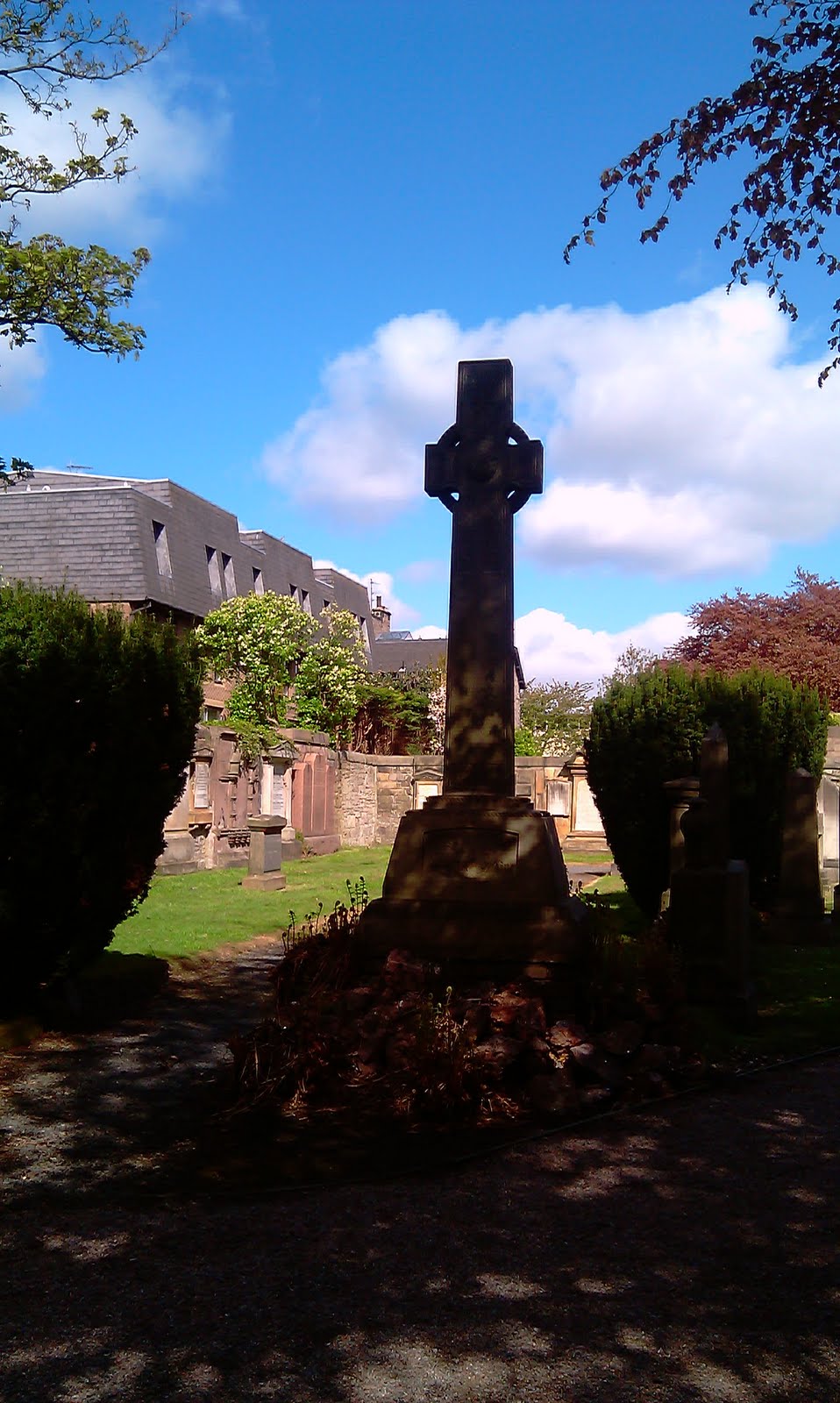 Yesterday I was able to visit the Edinburgh tomb of Lt. John Irving, RN, of the Franklin Expedition. As many people will be aware this tomb contains the remains of an officer of the Franklin Expedition buried on King William Island, which were discovered by Lt. Schwatka. On the basis of a medal found associated with the grave, the remains were identified as those of Lt Irving.
Were they really Irving's bones? Who knows, but it was a privilege for me to see this beautiful Celtic cross in the immaculately maintained Dean's Cemetery in Edinburgh.
I was struck not only by the dignity of the monument and its setting, but also by the aptness of its carving. Right down the shaft of the cross, it bears the following inscription:
In memory of Lt. John Irving, RN. HM Ship Terror. Born 1815. Died in King William's Land 1848-9. Her Majesty's Ships Erebus and Terror left England in May 1845 under command of Sir John Franklin KCB to explore a North West Passage to the Pacific. [Note the 'a', not 'the'] After wintering 1845-6 at Beechey Island they sailed south down Franklin's Strait and entered the NW Passage. Having been there beset with ice for two years Sir J Franklin and 8 other officers and 15 seamen having died the survivors 105 in number Lt. Irving being one landed on King William's Land and attempted to march to Canada but all died from cold and want of food. In 1879 Lt. Schwatka of the American searching expedition discovered Lt. Irving's grave. Through his kindness the remains of this brave and good officer were brought away and were deposited here on 7th January, 1881."
Below it is the quotation from the Bible - Romans 8:35 - "Who shall separate us from the love of Christ?" St. Paul went on to write: "Shall tribulation, or distress, or persecution, or famine, or nakedness, or danger, or sword?". The answer presumably was - no. In turn below that is the the famous wording from Horace, Odes III, 2, 13, which chillingly was used by Wilfred Owen for the title of of one of his most moving poems "Decorum est pro patria mori" - it is right to die for one's country. One wonders whether Owen was aware of this use of the quotation when he chose it as the title of his poem. And finally, there is an attractive bas relief showing the imaginary scene of the burial of Irving on King William Island. In the background can be seen the two ships Erebus and Terror. This does look rather similar to the bas relief on the Franklin Memorial in Waterloo Place, London, except without the more absurd fantasies of that one - no mountainous icebergs. And on Irving's tomb the mourners are shown holding nothing more unorthodox than a spade. Of course in reality I am not sure how much use a spade would have been for a gravedigger on King William Island - but at least the mourning sailors are not clutching bows and arrows as they appear to be in Waterloo Place! The bas relief is till in very good condition.
Of course when I spent my time before this cross I had two very different emotions. The historian in me mourned the loss of the young man buried below, and appreciated the quiet dignity of the tomb erected over him. But the archaeologist in me started to obsess about the potential for forensic evidence that was below my feet. Should we try to disinter these remains and see whether modern forensic research could find out more about this man and his unhappy death? Who knows?
Tuesday, 23 March 2010
An Excellent set of Daguerreotype images
I was very impressed with this set of images of the famous Franklin Expedition Daguerreotypes on the Scott Polar Research Institute's website:
http://www.spri.cam.ac.uk/library/pictures/catalogue/bnnpe1845-48/gallery/
The images of Couch and Stanley are especially interesting as they are of much better definition than most of the reproductions of their Daguerreotypes in circulation.
http://www.spri.cam.ac.uk/library/pictures/catalogue/bnnpe1845-48/gallery/
The images of Couch and Stanley are especially interesting as they are of much better definition than most of the reproductions of their Daguerreotypes in circulation.
Sunday, 28 February 2010
Raising Ghosts

When I started researching the life of James Fitzjames one of the things I always found odd was that he had no known date or place of death and no known date and place of birth. The earliest acknowledged date associated with him is his baptism on 27th February, 1815. That was the day, one hundred and ninety five years to the day yesterday, when 'James Fitzjames, gentleman' and 'Anne his wife' baptised their baby James at the Church of St. Mary-le-Bone in London.
Last year I spent a long time at the London Metropolitan Archive trying to track down any evidence relating to these parents. Like every other researcher into Fitzjames I could find nothing more about them. But from completely different lines of research, I now know the truth about Captain James Fitzjames, RN. I now know who he REALLY was, who his true family were and where he was born. Release of all of this information - and more - will have to wait until 'James Fitzjames, the Mystery Man of the Franklin Expedition' is published in July.
Yesterday being the 195th anniversary of this baptism, I made a little private pilgrimage to the grave of James Fitzjames' true father. I made the same journey to this grave that Fitzjames himself must have made in those brief months he had in England between returning with HMS Clio in late 1844 and departing on the Franklin Expedition on HMS Erebus in 1845. He had never been able to acknowledge his father, so sharing this secret and this journey with his memory made for a slight, strange bond between author and subject. I wondered what he must have thought and felt, and whether his shoes got as wet as mine on the ill-drained soil.
After paying my respects at this place, the closest thing Fitzjames has to a grave, I made my way, deep in thought, to the Church of St. Mary-le-Bone. Here this man, whose grave I had just visited and who called himself 'James Fitzjames, gentleman' had baptised his little child one hundred and ninety five years ago to the day. Round the corner, having eaten a beautiful roast pork sandwich from a Hogroast in the Churchyard (recommended, www.hog-father.com), I made my way to the Prince Regent pub. There I drank a private toast to the memory of Captain James Fitzjames, RN with a pint of excellent, and appropriately named, Adnam's Broadside ale.
I cannot help feeling that if ghosts exist I must have disturbed, if not raised, a few who must have felt that no mortal would ever stick his nose into their affairs again.
Thursday, 10 December 2009
Drinks in Memory of James Fitzjames
There are several reasons why I refer to James Fitzjames in my book as the ‘Mystery Man’ of the Franklin Expedition. For example, it is strange that for a public figure of some importance there is no true record of his birth and no record at all of his death.
We know that all 129 men on the Franklin Expedition died, but we only have the dates and times of deaths for four of them. Sir John Franklin died on 10th June, 1847, almost certainly on board HMS Erebus off the coast of King William Island and two sailors and one Royal Marine died in the winter of 1845-1846 off Beechey Island. The dates of their deaths are given in my earlier blog posting.
Fitzjames was baptised at the church of St. Mary-le-Bone in London on 27th February, and his birth was recorded there as having taken place on 24th July, 1813. But the father and mother whose names appear on this, ‘James Fitzjames, gentleman’ and ‘Ann Fitzjames’ his wife, simply do not appear in any other records anywhere else in the world. As my book will make clear, these were false names.
Who knows when anyone last commemorated the life of James Fitzjames or mourned his death? Well, in 2010 I will. Just around the corner from the Church of St. Mary-le-Bone is a particularly splendid pub. One hundred and ninety five years to the day after Fitzjames’ christening, I shall be standing in this pub and I shall raise a glass of beer to the memory of this fine man. That’s Saturday, 27th February, 2010. This is entirely the correct commemoration for a man who wrote from HMS Erebus, out in the Atlantic on Wednesday 11th June, 1845: “the sea is of the most perfect transparency — a beautiful, delicate, cold-looking green, or ultramarine. Long rollers, as if carved out of the essence of glass bottles, came rolling towards us; now and then topped with a beautiful pot-of-porter-looking head”. A man who can come up with such a wonderfully alcoholic description of the sea does not deserve to be forgotten.
Something else will make this occasion special. Fitzjames gave a single rose to Elizabeth Coningham when he left England. She kept it all her life and it remains in the hands of her family to this day. It was to her that he wrote the letter I have quoted from. Earlier on Tuesday 27th February, I will have made a solitary pilgrimage to the grave of the man who I now know to be Fitzjames’ real father. This man’s grave is the closest thing we have to a grave for Fitzjames. I shall lay a single rose on it in memory of his son James Fitzjames. But the identity of Fitzjames’ father will remain private until the book is published in July.
Anyone who wants to join me for this rather special day – in the pub, that is – is most welcome to email me or contact me via the blog and I will send you an invitation.
We know that all 129 men on the Franklin Expedition died, but we only have the dates and times of deaths for four of them. Sir John Franklin died on 10th June, 1847, almost certainly on board HMS Erebus off the coast of King William Island and two sailors and one Royal Marine died in the winter of 1845-1846 off Beechey Island. The dates of their deaths are given in my earlier blog posting.
Fitzjames was baptised at the church of St. Mary-le-Bone in London on 27th February, and his birth was recorded there as having taken place on 24th July, 1813. But the father and mother whose names appear on this, ‘James Fitzjames, gentleman’ and ‘Ann Fitzjames’ his wife, simply do not appear in any other records anywhere else in the world. As my book will make clear, these were false names.
Who knows when anyone last commemorated the life of James Fitzjames or mourned his death? Well, in 2010 I will. Just around the corner from the Church of St. Mary-le-Bone is a particularly splendid pub. One hundred and ninety five years to the day after Fitzjames’ christening, I shall be standing in this pub and I shall raise a glass of beer to the memory of this fine man. That’s Saturday, 27th February, 2010. This is entirely the correct commemoration for a man who wrote from HMS Erebus, out in the Atlantic on Wednesday 11th June, 1845: “the sea is of the most perfect transparency — a beautiful, delicate, cold-looking green, or ultramarine. Long rollers, as if carved out of the essence of glass bottles, came rolling towards us; now and then topped with a beautiful pot-of-porter-looking head”. A man who can come up with such a wonderfully alcoholic description of the sea does not deserve to be forgotten.
Something else will make this occasion special. Fitzjames gave a single rose to Elizabeth Coningham when he left England. She kept it all her life and it remains in the hands of her family to this day. It was to her that he wrote the letter I have quoted from. Earlier on Tuesday 27th February, I will have made a solitary pilgrimage to the grave of the man who I now know to be Fitzjames’ real father. This man’s grave is the closest thing we have to a grave for Fitzjames. I shall lay a single rose on it in memory of his son James Fitzjames. But the identity of Fitzjames’ father will remain private until the book is published in July.
Anyone who wants to join me for this rather special day – in the pub, that is – is most welcome to email me or contact me via the blog and I will send you an invitation.
Sunday, 29 November 2009
The remarkable background of Lt. Graham Gore
While my research recently has focused on James Fitzjames, Graham Gore is another of Franklin’s officers whose story has been obscured. There are some parallels between the two men. It is often said that aristocratic privilege played a great part in the selection of officers for the Franklin Expedition, yet Gore’s father seems to have been illegitimate and to have started his career in the merchant marine rather than as a 'young gentleman Volunteer'.
The story starts with Graham Gore’s grandfather John Gore. John Gore was born in America, possibly Virginia, in 1729 or 1730(1). John Gore senior entered the Royal Navy in 1755 and in 1764 had sailed around the world in HMS Dolphin(2). In 1766, he sailed again in the Dolphin to "discover" the island of Tahiti. With this experience he was naturally selected by Captain Cook as one of his two Lieutenants on HMS Endeavour(3) for his famous first voyage to Tahiti in 1768 to observe the transit of Venus. During this voyage Gore senior become friends with Joseph Banks the scientist. In 1772, while on half pay, Gore senior and Banks had made a private scientific expedition to Iceland together(4).
This private expedition to Iceland prevented Gore senior from serving on Cook’s second expedition, but in 1776 he sailed again with Cook on Cook’s third and final expedition, as First Lieutenant of HMS Resolution(5). The expedition's secret instructions were to trace the west coast of the North American continent northwards as part of the search for the North-West passage. After exploring the Bering Straits, Cook returned to the Pacific and was killed at Hawaii. On his death Captain Clerke took command of HMS Resolution and Gore senior transferred to command HMS Discovery. On Clerke’s death in turn from TB on 22nd August 1779, Gore senior transferred back again to HMS Resolution and took command of the entire expedition. Thus Graham Gore’s grandfather actually ended his sea-going career as commander of Cook’s Third Expedition.
On his final return to England Gore senior retired as a Captain of Greenwich Hospital, where he lived in the rooms Cook had occupied. He died there in 1790 at the age of sixty.
John Gore senior’s son was also called John. This John Gore was born on 7th March, 1774. Cliff Thornton of the Captain Cook Society has confirmed that he was born at Barking in Essex (other genealogical researchers had transcribed this as 'Boking') although the Royal Navy records his place of birth as London(6). There seem to be well-seated doubts as to whether this son’s birth was legitimate or not. When Gore senior sailed again he placed the two year old boy in the care of the Rev. Firebrace of Braintree in Essex with Sir Joseph Banks acting as his guardian(7).
John Gore first went to sea at the age of eleven, in 1785. This was not service in the Royal Navy, but a commercial venture arranged by a friend of his father called Nathanial Portlock. Portlock had served on Cook’s third voyage of exploration as an Able Bodied seaman on HMS Discovery, although he was soon appointed master's mate. Portlock’s 1785 voyage in the ‘King George’ and the ‘Queen Charlotte’ was a fur-trading venture to the American north-west coast which returned to England in 1787(8) having twice over-wintered twice in Hawaii and traded at Macao before returning home round the world(9).
Thus it was that when John Gore first entered the Royal Navy on HMS Guardian in 1789 at the age of fifteen he had already sailed around the world. O'Byrne's Naval Directory states that he was entered as an Able Bodied Seaman(10) but Cliff Thornton of the Captain Cook Society has told me that the Muster Book for HMS Guardian, (ADM36/11005) shows that he was entered as a Midshipman. HMS Guardian was commanded by Lieutenant Edward Riou, another former shipmate of John Gore senior who had served on Cooke’s third expedition – Riou had been a Midshipman on HMS Discovery(11).
The Guardian was Riou’s first command. HMS Guardian was a Royal Navy frigate which had been converted into a transport and was engaged in a vital task – bringing vitally needed supplies from England to the struggling penal colony which Britain had established in 1788 at Sydney Cover, New South Wales(12). The story of the ‘First Fleet’, which established British settlement in Australia is well known. The Guardian sailed from Spithead on 2nd September 1789 loaded with over a thousand tons of supplies, including a ‘garden’ of plants and seedlings selected by Sir Joseph Banks as being of use to the newly established colony on the other side of the world and livestock. On Christmas Eve, 24th December, 1789, HMS Guardian was off Marion Island, 1,300 miles from the Cape of Good Hope and short of fresh water when the lookout spotted an iceberg. Riou decided to pick up ice to replenish his fresh water tanks, which were being depleted at an alarming rate not just by his crew but also by the plants and livestock he was trying to keep alive. Despite towering seas and terrible weather conditions, the ship’s jolly boat was launched to collect ice from the berg. While it was doing so the Guardian collided violently with the iceberg, losing her rudder and being holed below the water-line. Riou seems to have had great difficulty controlling his crew and the convicts under these desperate conditions and on the following day, Christmas Day, gave an ‘every man for himself’ order. Some of the crew left in five ships’ boats. Only one, with fourteen survivors, was ever seen again. Some drunken men and convicts simply jumped into the sea, so imminent did it seem that the Guardian would sink. ‘I am inclined to think’ Riou wrote ‘they could but have survived a few minutes’. Riou was the only commissioned officer. John Gore was among the men who stayed with Riou and helped him eventually bring the stricken Guardian back to the Cape. During the voyage Gore seems to have been promoted to Master’s Mate. Under these dire circumstances ability and leadership counted for more than accident of birth. Although this epic story of survival has since been all but forgotten, it created a sensation at the time(13).
O’Byrne’s Directory says that he was next ‘attached, from July 1791, until September 1793, to the Assistant armed tender, Lieut-Commander Nathaniel Portlock ... engaged, in company with HMS Providence, in carrying the bread-fruit plant to the West Indies’. HMS Providence was captained by William Bligh and the Assistant was her escort. Bligh had already returned from the Pacific following the mutiny on HMS Bounty in 1787. The voyage of the Providence and the Assistant in August 1791 was to complete his original mission. The ships sailed for the Pacific and successfully conveyed breadfruit to the West Indies, returning to England in February 1794. I am grateful again to Cliff Thornton of the Captain Cook Society for clarifying this. [Incidentally, I live just down the road from Captain Blight's London town house which externally is unchanged since he lived in it. I think about the interplay between past and present whenever I pass it on the 159 bus.]
After this service he was entered into HMS Namur on 31st March, 1795 and promoted to Lieutenant only five months later on 19th August 1795. From then he served more or less continuous on a succession of ships until coming ashore from HMS Marlborough at the age of thirty-four on 20th September, 1808(14), newly promoted to the rank of Commander. His service was distinguished. Under Captain Moore of the Indefatigable, he was strongly commended for bravery during the capture of three Spanish frigates laden with treasure and the destruction of a fourth off Cape St. Mary on 5th Oct, 1804(15).
While First Lieutenant of HMS Fame, Gore had married Sarah Gilmour at Portsmouth on 15th May, 1806. She was from Alverstoke in Southampton. The couple had six children who survived into adult-hood. The eldest was a boy, inevitably named John, who was born in 1807 and followed by a younger brother Graham, born in 1808 or 1809. After these two there were three daughters Anne, Charlotte and Eliza and a further son, Edward, who was born in 1817. Evidence suggests the family settled in the Plymouth area. Graham’s Royal Naval records give his place of birth as Plymouth(16) and a letter from John Gore to the Admiralty says of Graham, aged eleven, that he had been “educated by myself and Mr. Bridge, Schoolmaster of Barnstaple”(17). When not in London or at sea, Gore wrote from an address at Bickington which was then a small village only two miles from Barnstaple, so this evidence is all consistent. It seems therefore that Gore was at home on half pay partly to educate his family and help his wife Sarah bring up the family.
Gore certainly attempted to gain further seagoing appointments(18) but only went to sea again once as Captain of the sloop HMS Dotterel from 12th February 1818 until 20th July, 1821. The first voyage of the Dotterel under Gore was part of the resupply convoy for the British garrison at St. Helena. St. Helena was hard pressed to support the large establishment which was guarding Napoleon, exiled for life there. It must be presumed therefore that John Gore had the opportunity then of meeting the exiled former Emperor. Another officer who must have made the acquaintance of Napoleon was a twenty two year old Irishman serving as a Mate on the Dotterel: Francis Crozier(19). After this voyage the Dotterel settled down to a relatively quiet routine of patrols in the Irish Sea and the coastal waters of Britain. Gore was presumably able to stay in touch with his family during this time. Crozier seems to have become bored with this promotion dead-end and volunteered for Arctic duty. Perhaps he was inspired to do so by hearing his Captain’s retelling of the stories of his youth in the Southern Ocean and the far northern Pacific, and of Cook's attempts to enter the North West Passage? Either way, Crozier was accepted by Edward Parry and was discharged from HMS Dotterel on 13th February, 1821 before the Dotterel’s commission ended. He joined HMS Fury, the bomb-ship specially converted for Arctic exploration. This was Crozier’s first step towards his ultimate death on the Franklin Expedition more than twenty-five years later.
Crozier was not the only member of the Dotterel’s company to die on the Franklin Expedition. We have seen that Gore had taken at least partial responsibility for the education of his family. On 24th November, 1819, he had entered his elder son John onto HMS Dotterel. The records suggest that the thirteen year old John may have first been entered as an Able Bodied seaman and then transferred to the rank of Midshipman as a Volunteer of the first class. Perhaps this was done to enable John Gore to take the lad to sea without having to obtain Admiralty authority to enter him as a Volunteer? One of the responsibilities of a Captain in relation to his ‘young gentleman Volunteers’ was to supervise their education so, although life for all members of the early nineteenth century Royal Navy was tough, this position was a natural one for Gore to arrange to continue his family’s education. At the end of the Dotterel’s commission on 20th July, 1821, Gore senior was promoted to Captain and arranged for his son John to attend the Royal Naval College, then at Portsmouth, where John passed out with a prize for mathematics(20).
The sloop had a complement of three Volunteers of the First Class(21). At the beginning of 1820, Gore had a vacancy for one. He wrote to the Admiralty from his anchorage at Cork on 2nd January, 1820, to say that ‘being a vacancy in the sloop I command for a volunteer of the first class boys, I have to request you will be pleased to move their Lordships to permit me to enter Mr. George Rawe Hallett, aged 15 years (son of Mr. John Hallett, surgeon of the Royal Navy) who has been educated by Mr. Godber of Fowey’(22). Permission was granted, but George Hallett was taken ill so Gore wrote again on 26th April 1820 ‘to permit me to enter my son Graham Gore, age 11 years, educated by myself and Mr. Bridge, Schoolmaster of Barnstaple’(23). The Admiralty had doubts about permitting such a young boy to be entered, but granted permission on 28th April, which was just as well as his father had already entered Graham on the books of his ship on the previous day(24).
Thus the three Gores, father and two sons, served together with Francis Crozier and the rest of the Dotterel’s company for nearly a year until Crozier’s appointment to the Fury. The three Gores remained aboard the ship until she paid off on 20th July, 1821. Graham seems to have lived at home for a further year, presumably with his now promoted father continuing his education, until he followed his elder brother to the Royal Naval College in 1822. John Gore senior, despite petitioning the Admiralty, never went to sea again and his eldest son John, having reached the rank of Lieutenant, was later drowned at sea.
Graham Gore next went to sea as a Midshipman on 10th April, 1824 and served until 31st August 1828 successively on HMS Ocean, HMS Albion and HMS Mosquito(25). On HMS Albion he fought in what was to prove to be the last ever battle between Nelson-era wooden sailing ships, the Battle of Navarino on 20th October, 1827. He passed for Lieutenant in 1829.
He made a hair-raising voyage to the Arctic from June 1836 to August 1837 as Mate on HMS Terror under the command of Captain Sir George Back. The Terror was badly damaged in this attempt to reach Repulse Bay, where it had been hoped to land a party to explore the Arctic coast of North America. The ship only just made it back across the Atlantic and had to be beached at the first land it reached in western Ireland. Such was the damage that the Terror was only held together by chains passed around the hull.
Graham Gore was then promoted to Lieutenant and entered HMS Modeste on 22nd November, 1837, followed by HMS Volage. On the Volage he took part in fighting in the first Anglo Chinese, or Opium War.
While in India he was posted to HMS Herald in Australia. But arriving in Sydney, Gore could not locate the Herald. Instead he found the famous HMS Beagle, of Darwin fame and volunteered to join her. He sailed on the Beagle from November 1840 until October 1843 under Captain John Lort Stokes on her famous third voyage, during which large parts of the Australian coast were accurately surveyed for the first time. It was during this voyage that the city of Darwin was named. Gore was a talented artist and served as unofficial artist on this voyage. One of his paintings hangs today in the National Library of Australia, depicting Burial Reach on the Flinders River in Queensland. Bizarrely, the Flinders River was named after Captain Matthew Flinders, who had been accompanied on some of his voyages of discovery in Australian waters by one Midshipman John Franklin.
Graham Gore narrowly escaped death at a place the Expedition subsequently named ‘Disaster Inlet’. He was shooting Cockatoos for food from a gig, in the company of Captain Stokes and some sailors. The mangrove trees in the inlet were ‘literally whitened with flocks of noisy cockatoos, giving the trees an appearance as if they were absolutely laden with huge flakes of snow—a somewhat remarkable aspect for a scene in such a clime to wear’, according to Stokes, who continued ‘soon the huge masses of white plumage began to float from tree to tree across the reach, whilst their screams as they flew by seemed a fair challenge to the sportsman. Mr. Gore accordingly resolved to secure a few of them for dinner, and put out his gun for the purpose’. When Gore fired, ‘ere the report of the gun had ceased to roll over the waters of the reach ... something whizzed past my ear, deafening and stupefying me for a moment--the next I saw my much-valued friend Gore stretched at his length in the bottom of the boat’. Gore’s gun had burst, leaving only a small portion of the barrel which fell back into the gig. Gore's hand was lacerated but he suffered no worse injury. According to Stokes, Gore himself broke the shocked silence with the immortal words ‘killed the bird...’ which Stokes described as ‘an expression truly characteristic of a sportsman’(26).
When the Beagle’s commission ended, he was entered onto the steamer Cyclops before arriving back in England in time for his next, and last, appointment to the Franklin Expedition in 1845. Sadly, that sealed his fate.
We can now see that his links with the Franklin Expedition were far deeper than hitherto have been understood. His grandfather had been a close associate of Sir Joseph Banks, who acted as the eminence grise to a whole series of British scientific expeditions. He himself had served with Crozier on the Dotterel. He had served under Stokes on the Beagle, and Stokes was a candidate the Admiralty considered to command the Expedition if Franklin declined it or had been declared unfit. It also transpires that Graham Gore’s father had a link with Fitzjames although that must remain under wraps until the publication of ‘James Fitzjames, the Mystery Man of the Franklin Expedition’. Lastly, the Gores can be seen to be much less of an ‘establishment’ family than is supposed. Technically speaking, both Graham and his father seem to have gone to sea first as sailors rather than as 'young gentleman Volunteers' and the senior Gore seems to have been illegitimate.
So what happened to Graham Gore’s family? With his eldest son dead and Graham at sea, at the age of sixty John Gore emigrated to New South Wales in 1834 with his wife Sarah, their three daughters Ann, Eliza and Charlotte and youngest son Edward on board 'City of Edinburgh'(27). The family first lived at Parramatta, then a small farming settlement near Sydney. Later they acquired 1,165 acres of land near Lake Bathurst in southern New South Wales where they settled in a house which they named 'Gilmour'. John Gore lived to know that he had been promoted by rote to Rear Admiral in 1852 and died in 1853(28). Sadly, before he died he would also have realised that his second son Graham would not be coming back from the Arctic. We now know from the Victory Point note that Graham Gore died sometime between June 1847 and April 1848 in the ice off King William Island. It is ironic that ice, the ultimate cause of his death, had almost caused the death of his father over half a century earlier in the great Southern Ocean.
Descendants of John Gore, and therefore relatives of Graham Gore, live to this day in Australia. While two of Graham Gore’s sisters, Ann and Charlotte, died unmarried, his sister Eliza married George Stewart in 1839 and had seven children and his brother Edward married Eliza Strang, who had two sons and a daughter. At least one descendant fought in the First World War, the appropriately named Private Rupert Franklin Gore Gallaway of the Australian 2nd Light Horse Regiment.
References
(1) http://www.captaincooksociety.com/ccsu41126.htm#REF1
(2) http://www.captaincooksociety.com/ccsu41126.htm#REF1
(3) http://www.captaincooksociety.com/ccsu70.htm
(4) http://www.captaincooksociety.com/ccsu41126.htm#REF1
(5) http://www.captaincooksociety.com/ccsu70.htm
(6) ADM 37/1208 says he was born in London
(7) http://www.captaincooksociety.com/ccsu41142.htm
(8) http://content.wisconsinhistory.org/cdm4/document.php?%289%29CISOROOT=/aj&CISOPTR=11778
(9) http://www.swmaritime.org.uk/forums/thread.php?threadid=1199
(10) O’Byrne, William - Naval Biography 2 vols. 1848.
(11) http://www.captaincooksociety.com/ccsu70.htm
(12) http://www.angelfire.com/trek/guardian/
(13) http://botanybaymedallion.com/?page_id=81
(14) ADM196/4
(15) London Gazette, 1804, p1310
(16) ADM107/74
(17) ADM1/1864, Letter Cap G53
(18) ADM1/1864, Letter Cap G25
(19) ADM37/6204
(20) ADM1/1864, Letter CapG53. In this letter John Gore writes from Barnstaple to say that ‘being apprised by the Lieutenant Governor of the Royal Naval College that a medal has been awarded to my son Mr. John Gore as the second best student that was discharged during the last half year, and that I should apply to the Lords Commissioners of the Admiralty for the same - I have therefore to request that you will be pleased to move their Lordships to cause the same to be forwarded to me’. This was refused. A dismissive note on the letter says that it should ‘delivered to any one who calls for it’.
(21) http://www.pbenyon.plus.com/Navy_List_1835/Young_Gentlemen.html
(22) ADM1/1864, Letter CapG17
(23) ADM1/1864, Letter CapG31
(24) ADM37/6204
(25) ADM107/74
(26) Discoveries in Australia, with an Account of the Coasts and Rivers Explored and Surveyed ...’ Volume 2, Stokes, John Lort.
(27) Information from Janet Syme, ibid
(28) http://newsarch.rootsweb.com/th/read/GORE/1998-08/0902767406
The story starts with Graham Gore’s grandfather John Gore. John Gore was born in America, possibly Virginia, in 1729 or 1730(1). John Gore senior entered the Royal Navy in 1755 and in 1764 had sailed around the world in HMS Dolphin(2). In 1766, he sailed again in the Dolphin to "discover" the island of Tahiti. With this experience he was naturally selected by Captain Cook as one of his two Lieutenants on HMS Endeavour(3) for his famous first voyage to Tahiti in 1768 to observe the transit of Venus. During this voyage Gore senior become friends with Joseph Banks the scientist. In 1772, while on half pay, Gore senior and Banks had made a private scientific expedition to Iceland together(4).
This private expedition to Iceland prevented Gore senior from serving on Cook’s second expedition, but in 1776 he sailed again with Cook on Cook’s third and final expedition, as First Lieutenant of HMS Resolution(5). The expedition's secret instructions were to trace the west coast of the North American continent northwards as part of the search for the North-West passage. After exploring the Bering Straits, Cook returned to the Pacific and was killed at Hawaii. On his death Captain Clerke took command of HMS Resolution and Gore senior transferred to command HMS Discovery. On Clerke’s death in turn from TB on 22nd August 1779, Gore senior transferred back again to HMS Resolution and took command of the entire expedition. Thus Graham Gore’s grandfather actually ended his sea-going career as commander of Cook’s Third Expedition.
On his final return to England Gore senior retired as a Captain of Greenwich Hospital, where he lived in the rooms Cook had occupied. He died there in 1790 at the age of sixty.
John Gore senior’s son was also called John. This John Gore was born on 7th March, 1774. Cliff Thornton of the Captain Cook Society has confirmed that he was born at Barking in Essex (other genealogical researchers had transcribed this as 'Boking') although the Royal Navy records his place of birth as London(6). There seem to be well-seated doubts as to whether this son’s birth was legitimate or not. When Gore senior sailed again he placed the two year old boy in the care of the Rev. Firebrace of Braintree in Essex with Sir Joseph Banks acting as his guardian(7).
John Gore first went to sea at the age of eleven, in 1785. This was not service in the Royal Navy, but a commercial venture arranged by a friend of his father called Nathanial Portlock. Portlock had served on Cook’s third voyage of exploration as an Able Bodied seaman on HMS Discovery, although he was soon appointed master's mate. Portlock’s 1785 voyage in the ‘King George’ and the ‘Queen Charlotte’ was a fur-trading venture to the American north-west coast which returned to England in 1787(8) having twice over-wintered twice in Hawaii and traded at Macao before returning home round the world(9).
Thus it was that when John Gore first entered the Royal Navy on HMS Guardian in 1789 at the age of fifteen he had already sailed around the world. O'Byrne's Naval Directory states that he was entered as an Able Bodied Seaman(10) but Cliff Thornton of the Captain Cook Society has told me that the Muster Book for HMS Guardian, (ADM36/11005) shows that he was entered as a Midshipman. HMS Guardian was commanded by Lieutenant Edward Riou, another former shipmate of John Gore senior who had served on Cooke’s third expedition – Riou had been a Midshipman on HMS Discovery(11).
The Guardian was Riou’s first command. HMS Guardian was a Royal Navy frigate which had been converted into a transport and was engaged in a vital task – bringing vitally needed supplies from England to the struggling penal colony which Britain had established in 1788 at Sydney Cover, New South Wales(12). The story of the ‘First Fleet’, which established British settlement in Australia is well known. The Guardian sailed from Spithead on 2nd September 1789 loaded with over a thousand tons of supplies, including a ‘garden’ of plants and seedlings selected by Sir Joseph Banks as being of use to the newly established colony on the other side of the world and livestock. On Christmas Eve, 24th December, 1789, HMS Guardian was off Marion Island, 1,300 miles from the Cape of Good Hope and short of fresh water when the lookout spotted an iceberg. Riou decided to pick up ice to replenish his fresh water tanks, which were being depleted at an alarming rate not just by his crew but also by the plants and livestock he was trying to keep alive. Despite towering seas and terrible weather conditions, the ship’s jolly boat was launched to collect ice from the berg. While it was doing so the Guardian collided violently with the iceberg, losing her rudder and being holed below the water-line. Riou seems to have had great difficulty controlling his crew and the convicts under these desperate conditions and on the following day, Christmas Day, gave an ‘every man for himself’ order. Some of the crew left in five ships’ boats. Only one, with fourteen survivors, was ever seen again. Some drunken men and convicts simply jumped into the sea, so imminent did it seem that the Guardian would sink. ‘I am inclined to think’ Riou wrote ‘they could but have survived a few minutes’. Riou was the only commissioned officer. John Gore was among the men who stayed with Riou and helped him eventually bring the stricken Guardian back to the Cape. During the voyage Gore seems to have been promoted to Master’s Mate. Under these dire circumstances ability and leadership counted for more than accident of birth. Although this epic story of survival has since been all but forgotten, it created a sensation at the time(13).
O’Byrne’s Directory says that he was next ‘attached, from July 1791, until September 1793, to the Assistant armed tender, Lieut-Commander Nathaniel Portlock ... engaged, in company with HMS Providence, in carrying the bread-fruit plant to the West Indies’. HMS Providence was captained by William Bligh and the Assistant was her escort. Bligh had already returned from the Pacific following the mutiny on HMS Bounty in 1787. The voyage of the Providence and the Assistant in August 1791 was to complete his original mission. The ships sailed for the Pacific and successfully conveyed breadfruit to the West Indies, returning to England in February 1794. I am grateful again to Cliff Thornton of the Captain Cook Society for clarifying this. [Incidentally, I live just down the road from Captain Blight's London town house which externally is unchanged since he lived in it. I think about the interplay between past and present whenever I pass it on the 159 bus.]
After this service he was entered into HMS Namur on 31st March, 1795 and promoted to Lieutenant only five months later on 19th August 1795. From then he served more or less continuous on a succession of ships until coming ashore from HMS Marlborough at the age of thirty-four on 20th September, 1808(14), newly promoted to the rank of Commander. His service was distinguished. Under Captain Moore of the Indefatigable, he was strongly commended for bravery during the capture of three Spanish frigates laden with treasure and the destruction of a fourth off Cape St. Mary on 5th Oct, 1804(15).
While First Lieutenant of HMS Fame, Gore had married Sarah Gilmour at Portsmouth on 15th May, 1806. She was from Alverstoke in Southampton. The couple had six children who survived into adult-hood. The eldest was a boy, inevitably named John, who was born in 1807 and followed by a younger brother Graham, born in 1808 or 1809. After these two there were three daughters Anne, Charlotte and Eliza and a further son, Edward, who was born in 1817. Evidence suggests the family settled in the Plymouth area. Graham’s Royal Naval records give his place of birth as Plymouth(16) and a letter from John Gore to the Admiralty says of Graham, aged eleven, that he had been “educated by myself and Mr. Bridge, Schoolmaster of Barnstaple”(17). When not in London or at sea, Gore wrote from an address at Bickington which was then a small village only two miles from Barnstaple, so this evidence is all consistent. It seems therefore that Gore was at home on half pay partly to educate his family and help his wife Sarah bring up the family.
Gore certainly attempted to gain further seagoing appointments(18) but only went to sea again once as Captain of the sloop HMS Dotterel from 12th February 1818 until 20th July, 1821. The first voyage of the Dotterel under Gore was part of the resupply convoy for the British garrison at St. Helena. St. Helena was hard pressed to support the large establishment which was guarding Napoleon, exiled for life there. It must be presumed therefore that John Gore had the opportunity then of meeting the exiled former Emperor. Another officer who must have made the acquaintance of Napoleon was a twenty two year old Irishman serving as a Mate on the Dotterel: Francis Crozier(19). After this voyage the Dotterel settled down to a relatively quiet routine of patrols in the Irish Sea and the coastal waters of Britain. Gore was presumably able to stay in touch with his family during this time. Crozier seems to have become bored with this promotion dead-end and volunteered for Arctic duty. Perhaps he was inspired to do so by hearing his Captain’s retelling of the stories of his youth in the Southern Ocean and the far northern Pacific, and of Cook's attempts to enter the North West Passage? Either way, Crozier was accepted by Edward Parry and was discharged from HMS Dotterel on 13th February, 1821 before the Dotterel’s commission ended. He joined HMS Fury, the bomb-ship specially converted for Arctic exploration. This was Crozier’s first step towards his ultimate death on the Franklin Expedition more than twenty-five years later.
Crozier was not the only member of the Dotterel’s company to die on the Franklin Expedition. We have seen that Gore had taken at least partial responsibility for the education of his family. On 24th November, 1819, he had entered his elder son John onto HMS Dotterel. The records suggest that the thirteen year old John may have first been entered as an Able Bodied seaman and then transferred to the rank of Midshipman as a Volunteer of the first class. Perhaps this was done to enable John Gore to take the lad to sea without having to obtain Admiralty authority to enter him as a Volunteer? One of the responsibilities of a Captain in relation to his ‘young gentleman Volunteers’ was to supervise their education so, although life for all members of the early nineteenth century Royal Navy was tough, this position was a natural one for Gore to arrange to continue his family’s education. At the end of the Dotterel’s commission on 20th July, 1821, Gore senior was promoted to Captain and arranged for his son John to attend the Royal Naval College, then at Portsmouth, where John passed out with a prize for mathematics(20).
The sloop had a complement of three Volunteers of the First Class(21). At the beginning of 1820, Gore had a vacancy for one. He wrote to the Admiralty from his anchorage at Cork on 2nd January, 1820, to say that ‘being a vacancy in the sloop I command for a volunteer of the first class boys, I have to request you will be pleased to move their Lordships to permit me to enter Mr. George Rawe Hallett, aged 15 years (son of Mr. John Hallett, surgeon of the Royal Navy) who has been educated by Mr. Godber of Fowey’(22). Permission was granted, but George Hallett was taken ill so Gore wrote again on 26th April 1820 ‘to permit me to enter my son Graham Gore, age 11 years, educated by myself and Mr. Bridge, Schoolmaster of Barnstaple’(23). The Admiralty had doubts about permitting such a young boy to be entered, but granted permission on 28th April, which was just as well as his father had already entered Graham on the books of his ship on the previous day(24).
Thus the three Gores, father and two sons, served together with Francis Crozier and the rest of the Dotterel’s company for nearly a year until Crozier’s appointment to the Fury. The three Gores remained aboard the ship until she paid off on 20th July, 1821. Graham seems to have lived at home for a further year, presumably with his now promoted father continuing his education, until he followed his elder brother to the Royal Naval College in 1822. John Gore senior, despite petitioning the Admiralty, never went to sea again and his eldest son John, having reached the rank of Lieutenant, was later drowned at sea.
Graham Gore next went to sea as a Midshipman on 10th April, 1824 and served until 31st August 1828 successively on HMS Ocean, HMS Albion and HMS Mosquito(25). On HMS Albion he fought in what was to prove to be the last ever battle between Nelson-era wooden sailing ships, the Battle of Navarino on 20th October, 1827. He passed for Lieutenant in 1829.
He made a hair-raising voyage to the Arctic from June 1836 to August 1837 as Mate on HMS Terror under the command of Captain Sir George Back. The Terror was badly damaged in this attempt to reach Repulse Bay, where it had been hoped to land a party to explore the Arctic coast of North America. The ship only just made it back across the Atlantic and had to be beached at the first land it reached in western Ireland. Such was the damage that the Terror was only held together by chains passed around the hull.
Graham Gore was then promoted to Lieutenant and entered HMS Modeste on 22nd November, 1837, followed by HMS Volage. On the Volage he took part in fighting in the first Anglo Chinese, or Opium War.
While in India he was posted to HMS Herald in Australia. But arriving in Sydney, Gore could not locate the Herald. Instead he found the famous HMS Beagle, of Darwin fame and volunteered to join her. He sailed on the Beagle from November 1840 until October 1843 under Captain John Lort Stokes on her famous third voyage, during which large parts of the Australian coast were accurately surveyed for the first time. It was during this voyage that the city of Darwin was named. Gore was a talented artist and served as unofficial artist on this voyage. One of his paintings hangs today in the National Library of Australia, depicting Burial Reach on the Flinders River in Queensland. Bizarrely, the Flinders River was named after Captain Matthew Flinders, who had been accompanied on some of his voyages of discovery in Australian waters by one Midshipman John Franklin.
Graham Gore narrowly escaped death at a place the Expedition subsequently named ‘Disaster Inlet’. He was shooting Cockatoos for food from a gig, in the company of Captain Stokes and some sailors. The mangrove trees in the inlet were ‘literally whitened with flocks of noisy cockatoos, giving the trees an appearance as if they were absolutely laden with huge flakes of snow—a somewhat remarkable aspect for a scene in such a clime to wear’, according to Stokes, who continued ‘soon the huge masses of white plumage began to float from tree to tree across the reach, whilst their screams as they flew by seemed a fair challenge to the sportsman. Mr. Gore accordingly resolved to secure a few of them for dinner, and put out his gun for the purpose’. When Gore fired, ‘ere the report of the gun had ceased to roll over the waters of the reach ... something whizzed past my ear, deafening and stupefying me for a moment--the next I saw my much-valued friend Gore stretched at his length in the bottom of the boat’. Gore’s gun had burst, leaving only a small portion of the barrel which fell back into the gig. Gore's hand was lacerated but he suffered no worse injury. According to Stokes, Gore himself broke the shocked silence with the immortal words ‘killed the bird...’ which Stokes described as ‘an expression truly characteristic of a sportsman’(26).
When the Beagle’s commission ended, he was entered onto the steamer Cyclops before arriving back in England in time for his next, and last, appointment to the Franklin Expedition in 1845. Sadly, that sealed his fate.
We can now see that his links with the Franklin Expedition were far deeper than hitherto have been understood. His grandfather had been a close associate of Sir Joseph Banks, who acted as the eminence grise to a whole series of British scientific expeditions. He himself had served with Crozier on the Dotterel. He had served under Stokes on the Beagle, and Stokes was a candidate the Admiralty considered to command the Expedition if Franklin declined it or had been declared unfit. It also transpires that Graham Gore’s father had a link with Fitzjames although that must remain under wraps until the publication of ‘James Fitzjames, the Mystery Man of the Franklin Expedition’. Lastly, the Gores can be seen to be much less of an ‘establishment’ family than is supposed. Technically speaking, both Graham and his father seem to have gone to sea first as sailors rather than as 'young gentleman Volunteers' and the senior Gore seems to have been illegitimate.
So what happened to Graham Gore’s family? With his eldest son dead and Graham at sea, at the age of sixty John Gore emigrated to New South Wales in 1834 with his wife Sarah, their three daughters Ann, Eliza and Charlotte and youngest son Edward on board 'City of Edinburgh'(27). The family first lived at Parramatta, then a small farming settlement near Sydney. Later they acquired 1,165 acres of land near Lake Bathurst in southern New South Wales where they settled in a house which they named 'Gilmour'. John Gore lived to know that he had been promoted by rote to Rear Admiral in 1852 and died in 1853(28). Sadly, before he died he would also have realised that his second son Graham would not be coming back from the Arctic. We now know from the Victory Point note that Graham Gore died sometime between June 1847 and April 1848 in the ice off King William Island. It is ironic that ice, the ultimate cause of his death, had almost caused the death of his father over half a century earlier in the great Southern Ocean.
Descendants of John Gore, and therefore relatives of Graham Gore, live to this day in Australia. While two of Graham Gore’s sisters, Ann and Charlotte, died unmarried, his sister Eliza married George Stewart in 1839 and had seven children and his brother Edward married Eliza Strang, who had two sons and a daughter. At least one descendant fought in the First World War, the appropriately named Private Rupert Franklin Gore Gallaway of the Australian 2nd Light Horse Regiment.
References
(1) http://www.captaincooksociety.com/ccsu41126.htm#REF1
(2) http://www.captaincooksociety.com/ccsu41126.htm#REF1
(3) http://www.captaincooksociety.com/ccsu70.htm
(4) http://www.captaincooksociety.com/ccsu41126.htm#REF1
(5) http://www.captaincooksociety.com/ccsu70.htm
(6) ADM 37/1208 says he was born in London
(7) http://www.captaincooksociety.com/ccsu41142.htm
(8) http://content.wisconsinhistory.org/cdm4/document.php?%289%29CISOROOT=/aj&CISOPTR=11778
(9) http://www.swmaritime.org.uk/forums/thread.php?threadid=1199
(10) O’Byrne, William - Naval Biography 2 vols. 1848.
(11) http://www.captaincooksociety.com/ccsu70.htm
(12) http://www.angelfire.com/trek/guardian/
(13) http://botanybaymedallion.com/?page_id=81
(14) ADM196/4
(15) London Gazette, 1804, p1310
(16) ADM107/74
(17) ADM1/1864, Letter Cap G53
(18) ADM1/1864, Letter Cap G25
(19) ADM37/6204
(20) ADM1/1864, Letter CapG53. In this letter John Gore writes from Barnstaple to say that ‘being apprised by the Lieutenant Governor of the Royal Naval College that a medal has been awarded to my son Mr. John Gore as the second best student that was discharged during the last half year, and that I should apply to the Lords Commissioners of the Admiralty for the same - I have therefore to request that you will be pleased to move their Lordships to cause the same to be forwarded to me’. This was refused. A dismissive note on the letter says that it should ‘delivered to any one who calls for it’.
(21) http://www.pbenyon.plus.com/Navy_List_1835/Young_Gentlemen.html
(22) ADM1/1864, Letter CapG17
(23) ADM1/1864, Letter CapG31
(24) ADM37/6204
(25) ADM107/74
(26) Discoveries in Australia, with an Account of the Coasts and Rivers Explored and Surveyed ...’ Volume 2, Stokes, John Lort.
(27) Information from Janet Syme, ibid
(28) http://newsarch.rootsweb.com/th/read/GORE/1998-08/0902767406
Sunday, 15 November 2009
More on Daguerreotyes
When the Illustrated London News published engravings of officers from the missing Franklin Expedition on 13th September, 1851, they did so with this note:
“The portraits upon the preceding page have been engraved from photographs by Mr. Beard. Previous to the sailing of the Erebus and Terror, Mr. Beard was commissioned to supply Sir John Franklin with a complete Daguerrotype apparatus, to take out with him; and with which, on board one of the ships, the accompanying Portraits were taken. Lady Franklin possesses one case of these likenesses, and Mr. Beard has another, which he has kindly permitted our artist to copy.
"The Erebus and Terror, it will be recollected, sailed from Greenhithe on May 18th, 1845. A portrait of Sir John Franklin, with views of the vessels, and two cabins of the Erebus, appeared in the ILLUSTRATED LONDON NEWS for May 24".
Wednesday, 21 October 2009
A 'new' Franklin Expedition Daguerreotype

Now here is some exciting news: the Wills family, relatives of Lt. Henry Le Vesconte of the Franklin Expedition, has identified a Daguerreotype of their lost relative previously unknown to Franklin Expedition researchers. The Daguerreotype remains in the hands of the family. They have kindly sent me a photo of it which is reproduced above.
This Daguerreotype appears to be either a similar or identical image to that of Le Vesconte held in Cambridge at the Scott Polar Research Institute. It appears therefore that either the pictures were taken immediately one after the other without the sitter altering his pose or, perhaps more likely, the 'photographer' Richard Beard had a Daguerreotype camera which could expose two plates at the same time. But the frame and case of this Daguerreotype is completely different and it obscures more of the original image than the Daguerreotype at Cambridge.
Let's now reassess where we know about the Franklin Expedition Daguerreotypes. We can now locate thirteen original Daguerreotypes from the Franklin Expedition: twelve in the SPRI collection and one in private hands. There are fourteen copies of Franklin Expedition Daguerreotypes in the Derbyshire County Archive at Matlock which appear to have been copied at an early date. Modern photographic copies of these 'Matlock' images are held by the National Maritime Museum. Most of the images at Matlock appear to be copies of the Daguerreotypes in Cambridge while others are copies of Daguerreotypes now lost. In no particular order then, here is the status of each one with a note about other portraits of each man:
Henry Le Vesconte, Lieutenant, HMS Erebus – there is a single Daguerreotype at Cambridge with a second identical Daguerreotype in his family's hands. There is a reversed copy of what appear to be the Cambridge image in the collection at Matlock.
Sir John Franklin, Captain, HMS Erebus – there is a single Daguerreotype at Cambridge with a reversed copy of what appear to be the Cambridge image in the collection at Matlock. There are quite a number of other portraits of Franklin in existence, including paintings and engravings.
Harry D.S. Goodsir, Assistant Surgeon, HMS Erebus – there is a single Daguerreotype at Cambridge with a reversed copy of what appear to be the Cambridge image in the collection at Matlock. A very early photograph of him also exists.
Charles Hamilton Osmer, Purser, HMS Erebus – there is a single Daguerreotype at Cambridge with a reversed copy of what appear to be the Cambridge image in the collection at Matlock.
Stephen Samuel Stanley, Surgeon, HMS Erebus – there is a single Daguerreotype at Cambridge with a reversed copy of what appear to be the Cambridge image in the collection at Matlock.
Henry Foster Collins, Second Master, HMS Erebus – there is a single Daguerreotype at Cambridge with an identical copy of the same image in the collection at Matlock.
Edward Couch, Mate, HMS Erebus – there is a single Daguerreotype at Cambridge with an identical copy of the same image in the collection at Matlock.
James Walter Fairholme, Lieutenant, HMS Erebus – there is a single Daguerreotype at Cambridge with an identical copy of the same image in the collection at Matlock.
Graham Gore, Lieutenant, HMS Erebus – there is a single Daguerreotype at Cambridge with an identical copy of the same image in the collection at Matlock.
James Reid, Ice Master, HMS Erebus – there is a single Daguerreotype at Cambridge with an identical copy of the same image in the collection at Matlock.
Charles Frederick Des Voeux, Mate, HMS Erebus – there is a single Daguerreotype at Cambridge with a copy of a different Daguerreotype in the collection at Matlock
James Fitzjames, Commander, HMS Erebus – there is a single Daguerreotype at Cambridge with a copy of a different Daguerreotype in the collection at Matlock. A beautiful chalk sketch of him is also held by the National Maritime Museum.
Francis Rawden Moira Crozier, Captain, HMS Terror – there is no surviving Daguerreotype but an early copy of one exists in the collection at Matlock
Robert Orme Sergeant, Mate, HMS Erebus – there is no surviving Daguerreotype but an early copy of one exists in the collection at Matlock.
It is clear that every officer on HMS Erebus was Daguerreotyped and in three cases - Fitzjames, Des Voeux and Le Vesconte – we now know that two Daguerreotypes were taken of each subject. I have heard it said that at one stage Graham Gore's family believed they held an original Daguerreotype but I have not been able to confirm this. If true that would a fourth confirmed 'double-Daguerreotype' and it would suggest that two were taken originally of every officer.
The two Daguerreotypes of Fitzjames and Des Voeux are clearly different images while the two of Le Vesconte seem to have been taken either simultaneously or immediately one after the other. The Le Vesconte images are also unique in that he is shown standing at the ship's wheel holding what appears to be the ship's log, whereas all the other officers were Daguerreotyped seated in what appears to be a curtained booth on the dock-side. Presumably the ship Le Vesconte was Daguerreotyped on board the Erebus and perhaps the Erebus was also the ship which can be seen in some of the reflections in the other Daguerreotypes, notably those of Gore and Fitzjames.
The only evidence that any Daguerreotypes were taken of Terror's officers is the single one of Crozier which survives as a copy at Matlock with the original now lost. It is possible that Crozier was the only officer on Terror to to be Daguerreotyped, although it may be that the accident of passing through Lady Franklin’s hands preserved the Erebus officers' Daguerreotypes. It is still possible that Daguerreotypes of some of Terror's officers may survive unrecognised in the hands of their families or of Daguerreotype dealers. A number of Terror's officers were social acquaintances of their counterparts on Erebus including Hodgson and Helpman so it would be a little surprising if they were not also Daguerreotyped.
Saturday, 17 October 2009
'Tom Bowline'
James Fitzjames is the subject of my forthcoming book, with a publication date targeted at July 2010. With the date on which the text will be frozen fast approaching (my publisher would point out that actually we have pased that date already...), I continue to find out more and more links with Fitzjames in all sorts of unlikely places. Here's one of them.
It is well known that Fitzjames fought in the First Anglo-Chinese War, or First Opium War as it is better known. This was a shameful episode in British history when the machinery of the state was manipulated by unscrupulous drug smugglers into forcing the Chinese government to allow the British to trade Opium with their subjects. Setting aside the morality of the War it was a brilliant demonstration of British military and naval superiority. As well as Fitzjames, a number of people who would become well-known in the Franklin story took part in it including Sir Edward Belcher, Henry Collinson and Richard Kellett.
It is fascinating to trace some of the different threads of the story over time. Fitzjames was a great humourist and a talented writer. During the War he served on HMS Cornwallis and he wrote a huge 10,000 word poem, 'The Cruise of the Cornwallis', which described the war in verse. I guess it was written in stages and recited over dinner for the amusement of his brother officers. After the War it was published anonymously in the Nautical Magazine where it can be found still to the general bemusement of its occasional reader. It was too long to include in my book, more's the pity, so when I've worked out how to do so I'll put it on the web with a link from this blog. Fitzjames was a fine poet but I don't think he would have claimed this as his best literary work. The subject matter can be extremely bloodthirsty but has flashes of quirky humour. Like this couplet, for example:
'We get plenty of rice, fowls, egg and chow-chow;
But no milk to our tea, though so near to My-cow'.
An asterisk at the bottom of the page explains that 'My-cow' means 'Macao'. Traditional Chinese cuisine does not include dairy products, so there we have it: 'No milk in Macao (= my cow)".
He published the poem anonymously and chose 'Tom Bowline' as his pseudonym. At that time 'Tom Bowline' was a generic name for a sailor like 'Jack Tar' is and like 'Tommy Atkins' would become for British soldiers. The name was popularised by a famous song "Poor Tom Bowline" by Charles Dibdin. Dibdin wrote it for his elder brother Tom who had been killed when he was struck by lightning at sea. This was not such an unusual occurrence then, as the traces of lightning conductor rod from the Erebus and the Terror found at Crozier's Landing will testify. But what extra-ordinary links with the past and the future Fitzjames' use of this name brings!
Dibdin was an eighteenth and early nineteenth century composer and actor who had written the music for Garrick's play 'The Padlock' which opened as far back as 1768. Dibdin had also acted in this play under the direction of Garrick. So Fitzjames' use of this pseudonym takes us back to the eighteenth century London of Garrick and Samuel Johnson. The mournful song remained popular throughout the nineteenth century, although at some point it changed its name from 'Tom Bowline' to 'Tom Bowling'.
Then in 1905 Sir Henry Wood put together his "Fantasia on British Sea Songs" to celebrate the centenary of the Battle of Trafalgar. He performed this every year at the last of his Promenade Concerts in London. Since then the 'Proms' have become world-famous as one of the greatest music festivals of the world and the "Fantasia on British Sea Songs" has been performed every year until 2008 when, sadly, the BBC dropped them. And Sir Henry was not the only twentieth century composer to use this song: it was a favourite of Benjamin Britten and Peter Pears and an arrangement by Britten has also been published.
The tradition at the Proms was for the song to be played slowly with much weeping and mourning from the Proms audience. What a bizarre link this is to James Fitzjames! For those who are not familiar with this strange British tradition, here are two links. The first is to a simple recital of the song as originally composed and sung by Robert Tear:
http://www.youtube.com/watch?v=awp2cmDMiF0
For those who prefer the more irreverent touch, here is a characteristic performance from the ninety-ninth season of the Proms in 1993 sung by John Tomlinson with the BBC Symphony Orchestra under Barry Wordsworth:
http://www.youtube.com/watch?v=2eQq4mUeDDM
Reminds me; must find an occasion to wear my white tux soon.
It is well known that Fitzjames fought in the First Anglo-Chinese War, or First Opium War as it is better known. This was a shameful episode in British history when the machinery of the state was manipulated by unscrupulous drug smugglers into forcing the Chinese government to allow the British to trade Opium with their subjects. Setting aside the morality of the War it was a brilliant demonstration of British military and naval superiority. As well as Fitzjames, a number of people who would become well-known in the Franklin story took part in it including Sir Edward Belcher, Henry Collinson and Richard Kellett.
It is fascinating to trace some of the different threads of the story over time. Fitzjames was a great humourist and a talented writer. During the War he served on HMS Cornwallis and he wrote a huge 10,000 word poem, 'The Cruise of the Cornwallis', which described the war in verse. I guess it was written in stages and recited over dinner for the amusement of his brother officers. After the War it was published anonymously in the Nautical Magazine where it can be found still to the general bemusement of its occasional reader. It was too long to include in my book, more's the pity, so when I've worked out how to do so I'll put it on the web with a link from this blog. Fitzjames was a fine poet but I don't think he would have claimed this as his best literary work. The subject matter can be extremely bloodthirsty but has flashes of quirky humour. Like this couplet, for example:
'We get plenty of rice, fowls, egg and chow-chow;
But no milk to our tea, though so near to My-cow'.
An asterisk at the bottom of the page explains that 'My-cow' means 'Macao'. Traditional Chinese cuisine does not include dairy products, so there we have it: 'No milk in Macao (= my cow)".
He published the poem anonymously and chose 'Tom Bowline' as his pseudonym. At that time 'Tom Bowline' was a generic name for a sailor like 'Jack Tar' is and like 'Tommy Atkins' would become for British soldiers. The name was popularised by a famous song "Poor Tom Bowline" by Charles Dibdin. Dibdin wrote it for his elder brother Tom who had been killed when he was struck by lightning at sea. This was not such an unusual occurrence then, as the traces of lightning conductor rod from the Erebus and the Terror found at Crozier's Landing will testify. But what extra-ordinary links with the past and the future Fitzjames' use of this name brings!
Dibdin was an eighteenth and early nineteenth century composer and actor who had written the music for Garrick's play 'The Padlock' which opened as far back as 1768. Dibdin had also acted in this play under the direction of Garrick. So Fitzjames' use of this pseudonym takes us back to the eighteenth century London of Garrick and Samuel Johnson. The mournful song remained popular throughout the nineteenth century, although at some point it changed its name from 'Tom Bowline' to 'Tom Bowling'.
Then in 1905 Sir Henry Wood put together his "Fantasia on British Sea Songs" to celebrate the centenary of the Battle of Trafalgar. He performed this every year at the last of his Promenade Concerts in London. Since then the 'Proms' have become world-famous as one of the greatest music festivals of the world and the "Fantasia on British Sea Songs" has been performed every year until 2008 when, sadly, the BBC dropped them. And Sir Henry was not the only twentieth century composer to use this song: it was a favourite of Benjamin Britten and Peter Pears and an arrangement by Britten has also been published.
The tradition at the Proms was for the song to be played slowly with much weeping and mourning from the Proms audience. What a bizarre link this is to James Fitzjames! For those who are not familiar with this strange British tradition, here are two links. The first is to a simple recital of the song as originally composed and sung by Robert Tear:
http://www.youtube.com/watch?v=awp2cmDMiF0
For those who prefer the more irreverent touch, here is a characteristic performance from the ninety-ninth season of the Proms in 1993 sung by John Tomlinson with the BBC Symphony Orchestra under Barry Wordsworth:
http://www.youtube.com/watch?v=2eQq4mUeDDM
Reminds me; must find an occasion to wear my white tux soon.
Wednesday, 12 August 2009
My biography of James Fitzjames
I am now getting very close to finalising my biography of James Fitzjames, Sir John Franklin's second in command on the doomed HMS Erebus of the Franklin Expedition.
One of the most rewarding things about this book for me has been peeling back the decades of neglect and uncovering the truth about the life of this remarkable man James Fitzjames. One thing that has never entirely been forgotten was his bravery in rescuing a man from drowning in the Mersey in 1834. Even in Dan Simmons' 'The Terror' this is mentioned, although Simmons has him being presented with 'a plate' as a reward for this.
Here is an extract from my book which tells what really happened and gives us a remarkably fresh connection with James Fitzjames:
'By February 1835 the 'George Canning' was ready to sail from Liverpool Docks. Fitzjames was optimistic, writing that ‘we are all in good health and spirits at the prospect of embarking in an undertaking which, if it succeeds according to our expectations, will be the most useful as well as the most delightful and interesting expedition ever sent from the shores of England.’ The last material to be taken on board was the substantial stock of gunpowder. While the dockyard workers and the ship’s company were loading this dangerous cargo on 1st February, 1835, Fitzjames distinguished himself with almost wanton bravery.
'The gunpowder was brought to the George Canning on a steamer tied up next to the ship. A Tidewaiter, or Customs official called James Dickinson slipped on the wooden gangplank between the two ships and fell into the fast moving and filthy waters of the Mersey. The tidal waters of the Mersey are very fast – Charlewood claimed the tide was running at six knots – and in a few seconds the man would be swept out of sight. Given that Dickinson could not swim his fate seemed sealed, especially as the weather was cold and there was a strong wind blowing. Without pausing for a second Fitzjames dived overboard into the Mersey after the man, not even stopping to take off his heavy greatcoat. Despite being encumbered by his clothing and boots, he was able to swim after the floundering man and reach him before he drowned. He seized him by the hair and trod water, holding the man’s head above water and preventing him from drowning. Fitzjames’ life and that of the man he had committed himself to now depended on the steamer tied up to the ‘George Canning’ casting off and steaming quickly enough to reach the two men in the water before exposure overcame Fitzjames. The crew of the steamer reacted fast, but it did not reach them until the tide had swept them at least half a mile along the Mersey estuary. Charlewood said that ‘never have I seen anything done so nobly’ and he ‘never felt so happy as when we saw him, once more safe on board.’
'Fitzjames’ clothing was ruined as was the very expensive pocket-watch which he had been carrying. In recognition of his bravery he was granted the Freedom of the City of Liverpool at a dinner in his honour and presented with a silver cup by the Corporation of Liverpool.
'Fitzjames seem to have been genuinely taken aback by the overwhelming response to his bravery. He wrote ‘it was quite extraordinary to see the kindly feelings that everybody entertained towards me after the affair in the Mersey. I was on shore all day afterwards and was stared at most tremendously; everybody I heard wanted to see me'. Modestly he added, 'the feat is I think said rather too much about it in the papers’.
'After the dinner, he brought the cup back to the ‘George Canning’ where ‘we filled it with mulled Port on board and the chaps drank my health’. Fitzjames cannot have been entirely sober as he had already been toasted at the dinner. The drinking of his health on board the ‘George Canning’ was a high-spirited affair and ‘by the by it [the cup] got a slight (sic) knock at the bottom in drowning and leaks a little there’. He asked Robert Coningham to look after the cup while he was away, and he arranged for Mr. Laird to send it to Rose Hill. He suggested Coningham might be able to mend the damage as ‘a little bit of solder would fill it up’.
'One hundred and seventy four years later, the cup is in the collection of the National Maritime Museum at Greenwich. I wrote to the Museum to recount this story, and Barbara Tomlinson, Curator, wrote back to say ‘This is most interesting. The cup is on display, I had a look inside (with a mirror) and there is indeed a small soldered patch in the bottom’.
The cup can be seen today online at http://www.nmm.ac.uk/collections/explore/object.cfm?ID=PLT0048
One of the most rewarding things about this book for me has been peeling back the decades of neglect and uncovering the truth about the life of this remarkable man James Fitzjames. One thing that has never entirely been forgotten was his bravery in rescuing a man from drowning in the Mersey in 1834. Even in Dan Simmons' 'The Terror' this is mentioned, although Simmons has him being presented with 'a plate' as a reward for this.
Here is an extract from my book which tells what really happened and gives us a remarkably fresh connection with James Fitzjames:
'By February 1835 the 'George Canning' was ready to sail from Liverpool Docks. Fitzjames was optimistic, writing that ‘we are all in good health and spirits at the prospect of embarking in an undertaking which, if it succeeds according to our expectations, will be the most useful as well as the most delightful and interesting expedition ever sent from the shores of England.’ The last material to be taken on board was the substantial stock of gunpowder. While the dockyard workers and the ship’s company were loading this dangerous cargo on 1st February, 1835, Fitzjames distinguished himself with almost wanton bravery.
'The gunpowder was brought to the George Canning on a steamer tied up next to the ship. A Tidewaiter, or Customs official called James Dickinson slipped on the wooden gangplank between the two ships and fell into the fast moving and filthy waters of the Mersey. The tidal waters of the Mersey are very fast – Charlewood claimed the tide was running at six knots – and in a few seconds the man would be swept out of sight. Given that Dickinson could not swim his fate seemed sealed, especially as the weather was cold and there was a strong wind blowing. Without pausing for a second Fitzjames dived overboard into the Mersey after the man, not even stopping to take off his heavy greatcoat. Despite being encumbered by his clothing and boots, he was able to swim after the floundering man and reach him before he drowned. He seized him by the hair and trod water, holding the man’s head above water and preventing him from drowning. Fitzjames’ life and that of the man he had committed himself to now depended on the steamer tied up to the ‘George Canning’ casting off and steaming quickly enough to reach the two men in the water before exposure overcame Fitzjames. The crew of the steamer reacted fast, but it did not reach them until the tide had swept them at least half a mile along the Mersey estuary. Charlewood said that ‘never have I seen anything done so nobly’ and he ‘never felt so happy as when we saw him, once more safe on board.’
'Fitzjames’ clothing was ruined as was the very expensive pocket-watch which he had been carrying. In recognition of his bravery he was granted the Freedom of the City of Liverpool at a dinner in his honour and presented with a silver cup by the Corporation of Liverpool.
'Fitzjames seem to have been genuinely taken aback by the overwhelming response to his bravery. He wrote ‘it was quite extraordinary to see the kindly feelings that everybody entertained towards me after the affair in the Mersey. I was on shore all day afterwards and was stared at most tremendously; everybody I heard wanted to see me'. Modestly he added, 'the feat is I think said rather too much about it in the papers’.
'After the dinner, he brought the cup back to the ‘George Canning’ where ‘we filled it with mulled Port on board and the chaps drank my health’. Fitzjames cannot have been entirely sober as he had already been toasted at the dinner. The drinking of his health on board the ‘George Canning’ was a high-spirited affair and ‘by the by it [the cup] got a slight (sic) knock at the bottom in drowning and leaks a little there’. He asked Robert Coningham to look after the cup while he was away, and he arranged for Mr. Laird to send it to Rose Hill. He suggested Coningham might be able to mend the damage as ‘a little bit of solder would fill it up’.
'One hundred and seventy four years later, the cup is in the collection of the National Maritime Museum at Greenwich. I wrote to the Museum to recount this story, and Barbara Tomlinson, Curator, wrote back to say ‘This is most interesting. The cup is on display, I had a look inside (with a mirror) and there is indeed a small soldered patch in the bottom’.
The cup can be seen today online at http://www.nmm.ac.uk/collections/explore/object.cfm?ID=PLT0048
Sunday, 28 June 2009
More on the Franklin Expedition Daguerreotypes

I owe a huge debt of thanks to Heather Lane, Librarian and Keeper of Collections at the Scott Polar Research Institute at Cambridge and her colleagues Lucy Martin, Picture Library Manager and Fiona Cahill, Conservator. Last Friday 26th June, they very kindly permitted me to see the original Daguerreotypes taken in 1845 of members of the Franklin Expedition in their collection and were extremely generous with their time and expertise. Here's a picture of me with one of the Daguerrreotypes.
What are the Daguerreotypes like? That's one of them in front of me on the desk. (Incidentally that is NOT a half-drunk bottle of scotch next to me - it's something mysterious in a bottle of theirs...) Each Daguerreotype is about 4 inches by 3 inches and is kept under glass in a neat little box. The detail on them is very fine, much more than appears to be the case from the reproductions which circulate on the internet at the moment, and most of them also have some slight colouring, which was a tinting applied to the image after it was taken. Here is a near-contemporary description of how they were taken:
What are the Daguerreotypes like? That's one of them in front of me on the desk. (Incidentally that is NOT a half-drunk bottle of scotch next to me - it's something mysterious in a bottle of theirs...) Each Daguerreotype is about 4 inches by 3 inches and is kept under glass in a neat little box. The detail on them is very fine, much more than appears to be the case from the reproductions which circulate on the internet at the moment, and most of them also have some slight colouring, which was a tinting applied to the image after it was taken. Here is a near-contemporary description of how they were taken:
and the FAQ’s of the Daguerreian Society are also instructive:
One point of significance is that a Daguerreotype is an original image, not a positive derived from a negative like a conventional photograph. As the Society’s FAQ’s say, it is “normally a reversed (or, correctly stated, a laterally-reversed) image. The only way to get a correct orientation was to copy the image with a second daguerreotype, or to make the original daguerreotype using a reversing prism or mirror. Besides the complexity, a problem with a reversing mirror was, if taken outdoors, it may be subject to movement by a breeze causing a blurred image. So typically people just lived with a reversed image”. There are twelve Daguerreotypes at the SPRI in total.
The other images in existence are what appear to be early copies of Franklin Expedition Daguerreotypes which are held at the Derbyshire County Archive in Matlock, and what appear to be photographs of these copies in the National Maritime Museum’s image collection, which you can see here:
The National Maritime Museum’s collection has fourteen images, which proves that fourteen of the twenty four officers on the Expedition were Daguerreotyped. A comparison of the images in the two collections suggests that perhaps more were originally taken. Here’s why. In ten cases, the image in the photograph in the National Maritime Museum is identical with that of the Daguerreotype now held at SPRI. This is true for Franklin, Reid, Collins, Stanley, Le Vesconte, Gore, Osmer, Fairholme, Couch and Goodsir, although five of them (Franklin, Stanley, Le Vesconte, Osmer and Goodsir) have been reversed. This suggests that they not all the copies were made at the same time. In two cases, Fitzjames and Des Voeux, the picture on the National Maritime Museum photograph is of a different Daguerreotype. It is well known that two Daguerreotypes were taken of Fitzjames – in the National Maritime Museum image he is holding a telescope and in the Daguerreotype at Cambridge he is not. But I don’t think it has previously been realised that the images of Des Voeux are also different – in the National Maritime Museum image he is hatless, but in the Cambridge Daguerreotype he is wearing a hat. And two officers appear on an image at the National Maritime Museum, Crozier and Sargent, although there is no Daguerreotype of either of them at Cambridge. This prompts some further questions:
1) What are the images at Matlock, from which apparently the National Maritime Museum photos were derived? They are undoubtedly taken from Daguerreotypes, but when were they made, by whom and with what process?
2) Were the Derbyshire images made directly from the original Daguerreotypes? Perhaps the ones which are reversed went through a further intermediate step?
3) Where are the Daguerreotypes of Crozier and Sargent, which the Derbyshire copyist had access to but which seem now to be lost?
4) If these two Daguerreotypes have been lost, could others have been lost also? Des Voeux and Fitzjames were both taken twice, so perhaps each officer was taken twice? It is noteworthy that in some Daguerreotypes the subject is wearing his hat and in others he is hatless. This might suggest that two Daguerreotypes were taken of each subject, one with and one without his hat, although Fitzjames is hatless in both images. That would suggest that twenty eight Daguerreotypes were taken – two of each officer – with sixteen surviving until the date the unknown copyist made the Derbyshire/National Maritime Museum copies, and twelve finding their way into the SPRI Collection at Cambridge.
5) Why, with the exception of Crozier, are all the officers taken from the Erebus? Was a similar set of Daguerreotypes taken of the officers on board the Terror? The connection with Derbyshire suggests that the Daguerreotypes which have survived may have passed through Lady Franklin’s hands. The Erebus was of course Sir John Franklin’s ship, so that might suggest why she kept these Daguerreotype. If two were taken of the officers on the Terror, do some of them still survive, unrecognised, in other museums, collections or in the hands of descendants or relatives?
I may be wrong with some of these speculations and there may be other questions which can be asked (and perhaps answered) too, but I hope this analysis and these questions can serve to help others take this picture research forwards. Before closing I’d just make a few more comments.
Dr. Huw Lewis-Jones of the Scott Polar Research Institute has already observed that in the polished peak of Lt. Gore’s cap can be seen what appears to be the reflection of the rigging of a ship. Most of the Daguerreotypes seem to have been taken in the same place and in fact what appears to be rigging or reflections of images derived from ships can also be seen in the peaks of Osmer’s, Fairholme’s and Goodsir’s caps as well. Someone with a skill at optics might be able to consolidate these reflected images and build up a better picture of the scene where these Daguerreotypes were taken.
The Scott Polar Research Institute have made really high quality digital copies of the Daguerreotypes in their collection, which will soon be published on their Freeze Frame website. This will be a superb resource for scholars of photography as well as of the Franklin Expedition and I am sure will enable a lot more information to be gleaned from these important images. I think people who are familiar with the National Maritime Museum images will be surprised by some of these. For example, the National Maritime Museum image of Collins is very overexposed, yet the SPRI Daguerreotype image of him is a superb and detailed portrait, as is that of Couch.
A final thought is that the lettering on the log-book which Lt. Le Vesconte is holding looks as though it is likely to be legible under a microscope.. That will be interesting – perhaps that is the closest we will ever get to reading the log of the Erebus?
1) What are the images at Matlock, from which apparently the National Maritime Museum photos were derived? They are undoubtedly taken from Daguerreotypes, but when were they made, by whom and with what process?
2) Were the Derbyshire images made directly from the original Daguerreotypes? Perhaps the ones which are reversed went through a further intermediate step?
3) Where are the Daguerreotypes of Crozier and Sargent, which the Derbyshire copyist had access to but which seem now to be lost?
4) If these two Daguerreotypes have been lost, could others have been lost also? Des Voeux and Fitzjames were both taken twice, so perhaps each officer was taken twice? It is noteworthy that in some Daguerreotypes the subject is wearing his hat and in others he is hatless. This might suggest that two Daguerreotypes were taken of each subject, one with and one without his hat, although Fitzjames is hatless in both images. That would suggest that twenty eight Daguerreotypes were taken – two of each officer – with sixteen surviving until the date the unknown copyist made the Derbyshire/National Maritime Museum copies, and twelve finding their way into the SPRI Collection at Cambridge.
5) Why, with the exception of Crozier, are all the officers taken from the Erebus? Was a similar set of Daguerreotypes taken of the officers on board the Terror? The connection with Derbyshire suggests that the Daguerreotypes which have survived may have passed through Lady Franklin’s hands. The Erebus was of course Sir John Franklin’s ship, so that might suggest why she kept these Daguerreotype. If two were taken of the officers on the Terror, do some of them still survive, unrecognised, in other museums, collections or in the hands of descendants or relatives?
I may be wrong with some of these speculations and there may be other questions which can be asked (and perhaps answered) too, but I hope this analysis and these questions can serve to help others take this picture research forwards. Before closing I’d just make a few more comments.
Dr. Huw Lewis-Jones of the Scott Polar Research Institute has already observed that in the polished peak of Lt. Gore’s cap can be seen what appears to be the reflection of the rigging of a ship. Most of the Daguerreotypes seem to have been taken in the same place and in fact what appears to be rigging or reflections of images derived from ships can also be seen in the peaks of Osmer’s, Fairholme’s and Goodsir’s caps as well. Someone with a skill at optics might be able to consolidate these reflected images and build up a better picture of the scene where these Daguerreotypes were taken.
The Scott Polar Research Institute have made really high quality digital copies of the Daguerreotypes in their collection, which will soon be published on their Freeze Frame website. This will be a superb resource for scholars of photography as well as of the Franklin Expedition and I am sure will enable a lot more information to be gleaned from these important images. I think people who are familiar with the National Maritime Museum images will be surprised by some of these. For example, the National Maritime Museum image of Collins is very overexposed, yet the SPRI Daguerreotype image of him is a superb and detailed portrait, as is that of Couch.
A final thought is that the lettering on the log-book which Lt. Le Vesconte is holding looks as though it is likely to be legible under a microscope.. That will be interesting – perhaps that is the closest we will ever get to reading the log of the Erebus?
Friday, 10 April 2009
Is the conventional interpretation of the ‘Victory Point’ note wrong?
The Franklin Expedition was last seen on either 29th or 31st July, 1845, when the tips of their ships’ masts were visible to Captain Martin of the whaler ‘Enterprise’ in the eastern reaches of Baffin Bay. Martin’s position then was 75 12' N, 61 6' W. From the Victory Point note we know they became beset off King William Island on 12th September, 1846, and from the graves at Beechey Island we know they over-wintered there in 1845-1846. Almost the only other significant information we have about what happened between these dates is given in this extract from the Victory Point note, and its duplicate also left on King William Island:
“HM Ships Erebus and Terror 28 of May 1847 Wintered in the Ice in Lat 70 5 N. Long 98 23 W Having wintered in 1846-7 at Beechey Island in Lat 74 43 28 N. Long. 91 39 15 W after having ascended Wellington Channel to Lat. 77. and returned by the West side of Cornwallis Island.”
This has always been read to mean that in the summer and autumn of 1845 the Expedition sailed past Beechey Island, up Wellington Channel to 77N, and then back south and east via the west side of Cornwallis Island to overwinter 1845-6 back at Beechey Island. (From the graves there we know the ‘wintering’ there took place in 1845-6 and not 1846-7). Then in spring / summer 1846 it left Beechey Island and sailed west and then south towards the North American coastline before becoming beset. But this depends on whether we think Fitzjames intended “having wintered ...at Beechey Island” to be a subjunctive clause or the start of a second sentence. The conventional interpretation
“HM Ships Erebus and Terror 28 of May 1847 Wintered in the Ice in Lat 70 5 N. Long 98 23 W. Having wintered in 1846-7 at Beechey Island in Lat 74 43 28 N. Long. 91 39 15 W after having ascended Wellington Channel to Lat. 77. and returned by the West side of Cornwallis Island.”
could equally read:
“HM Ships Erebus and Terror 28 of May 1847 Wintered in the Ice in Lat 70 5 N. Long 98 23 W, having wintered in 1846-7 at Beechey Island in Lat 74 43 28 N. Long. 91 39 15 W, after having ascended Wellington Channel to Lat. 77. and returned by the West side of Cornwallis Island.”
As far as I can tell from textual examination, either is possible. Which is more likely?
I make the distance from Martin’s position in Baffin Bay to the 77N position north of Cornwallis Island, then back to Beechey Island by the west of Cornwallis Island, to be about 850 nautical miles. If they made this voyage in 1845, the Expedition would have had to maintain an average speed of c.0.4 knots over the whole journey, or almost 750 metres per hour, 24 hours a day, even without stopping to take magnetic observations. By contrast their 1846 voyage, from Beechey Island to the position they became beset off King William Island, a distance of about 320 nautical miles, would only have required an average speed of 0.1 knots, or under 200 metres per hour.
But if in 1845 they only sailed from Martin’s position as far as Beechey Island, a distance of 440 nautical miles, their average speed would only have needed to have been c.0.2 knots, or 370 metres per hour. Then in 1846 they would have had to have sailed from Beechey Island north to 77N, then turned back and sailed south by the west of Cornwallis Island to the point where they became beset, which is a distance of just over 700 nautical miles. That would have required an average speed of c0.3 knots, or about 550 metres per hour. The conventional interpretation suggests they made an extremely fast voyage in 1845 and a very slow one in 1846. The alternative interpretation permits more consistency in their progress. There are a couple of logical arguments which suggest that the ‘alternative’ explanation may have some merit.
· Sherard Osborn made an interesting comment about the assumed magnetic observatory at Cape Riley, which was close to their Beechey Island anchorage. The expedition was charged with taking very detailed magnetic observations on certain specific dates, which were called Term Dates. The idea was that on Term Dates, every magnetic observatory around the world would take readings at exactly the same time. Later, when all the readings could be analysed together, they would make possible retrospective global analysis of fluctuations in the Earth’s magnetism. The Term Date after the Expedition left Disko Island was 29th August, 1845. Osborne suggested the Expedition was very likely to have been at Cape Riley on 29th August, 1845, and if so there would have been very little time afterwards to make the long voyage to 77 degrees North and then back to Beechey Island before winter set in.
· If the Expedition returned to Beechey Island in 1845 after ascended Wellington Channel to 77 degrees north, why did it do so by the west side of Cornwallis Island? This makes no sense when Beechey Island lay to the south and east of their position. Also, their maps did not show Cornwallis Island to be an island, so how could they have known that an unexplored channel to its south and west would lead them back where they wanted to go? But this route would makes sense if they made the ascent to 77N in 1846, as it would have allowed a much more direct route south to Peel Sound. There would have been time in 1845-6 for parties to have surveyed the area, and Peel Strait and the west of Cornwallis Island both lie within 100 nautical miles of Beechey Island. We know there were traces of sledging expeditions sent out from the Erebus and Terror in the snow and ice on the land around Beechey Island, but trails along the sea ice would not have survived.
The truth is that we don’t know which of these interpretations of the Victory Point note is correct, and we never will unless further written evidence comes to light. The only facts we know about what happened after the ships left Captain Dannet is that they overwintered 1845-6 at Beechey Island, became beset off King William Island on 12th September 1846 and before doing so attempted the North West Passage firstly to the north and then secondly to the south.
Monday, 23 March 2009
The graves on Beechey Island
While we all hope that one day more written material will emerge from all the archaeological research into the Franklin Expedition, can we learn any more from what has already been found? Amongst the most poignant memorials of the Franklin Expedition are the graves of the three crewmembers who died on Beechey Island in 1846 during the first winter of the Expedition. While Dr. Owen Beattie and his team members have carried out a great deal of invaluable pathological research into the remains of the three men, little attention has been paid to the possible meanings of the inscriptions on the graves themselves. Each had an inscribed wooden headboard with the following inscriptions:
- “Sacred to the memory of John Torrington, who departed this life January 1st, A.D.1846, on board of HM ship Terror, aged 20 years”
- “Sacred to the memory of John Hartnell, AB, of HMS Erebus, died January 4th, 1846, aged twenty-five years. “Thus saith the Lord of Hosts, consider your ways.” Haggai, I, 7”
- “Sacred to the memory of William Braine, RM of HMS Erebus, died April 3rd, 1846, aged thirty-two years. “Choose ye this day whom you will serve”, Joshua xxiv, 15”
The choice of texts for the second and third deaths puzzled observers and still does today. And why had John Torrington not earned a text on his grave? Some commentators have said that these are forbidding inscriptions – ‘consider your ways!’ and ‘choose.. whom you will serve?’ It has been suggested they might signify dissent or even mutiny on the Expedition.
Why does John Torrington not have a Biblical quotation? This surely is because of the different characters of the two Captains, Crozier and Franklin. While Crozier was a conventional Anglican, Franklin had a real sense of Christian mission. John Torrington died aboard HMS Terror so Captain Crozier would have taken his funeral service and presumably chose not to put a text on the grave. The other two men were from HMS Erebus where Sir John Franklin was Captain. Franklin took his duties as spiritual leader very seriously. We know he held a Church service every Sunday and we even know what some of these services were like. Franklin took the first service of the Expedition on Sunday 18th May, 1845. After it Lieutenant Couch described him as ‘quite a Bishop. … Gives sermons out of his sermon books, and I can assure you add a great deal himself. They say they would sooner hear him than half the parsons of England’. Fitzjames wrote of the same service: ‘I like a man who is in earnest... Every one was struck with his extreme earnestness of manner, evidently proceeding from real conviction’. Fairholme said that Franklin had ‘the most beautiful and impressive manner I ever heard, even in a clergyman’ adding that ‘the service here is very different from in most ships’. On Sunday, 25thMay, 1845, when Franklin took the second service of the Expedition, he preached his sermon on 1 Kings xvii 16th verse: ‘and the barrel of meal wasted not, neither did the cruse of oil fail, according to the word of the Lord’. He drew a straightforward message for the crew from the Old Testament text he selected - that the Expedition was well supplied with provisions and, provided they retained their faith, they would achieve their goal and come to no harm. Sergeant Daniel Bryant, Royal Marines, said that ‘Sir John called the ship’s company’s attention to that part of the sermon: and the whole of the ship’s company were very much pleased with Sir John’s appropriate text, and united in this point of view with Sir John, to accomplish our object which we have in view’. Franklin also held a second, more informal, service in his cabin every Sunday evening and Sergeant Bryant was so impressed with the ‘cruse of oil’ sermon that he said he would attend the evening sermon too, writing that ‘I shall always go as long as I am able. I could remain for hours to hear him.’ Both ships were fitted with barrel organs which could play ten psalm or hymn tunes, so these services had a musical accompaniment.
The Funerals of these men would have been important occasions and Franklin would have put in a lot of thought into the address he would preach at each. The text on the headboards must surely reflect his address. It would be strange to preach a sermon on one text and then inscribe a completely different one, and an obscure one, on the headboard. Can we draw any inferences from these texts which might inform us about what Franklin was trying to tell his men in these funeral addresses?
Hartnell’s text comes from the Book of Haggai. This was an exhortation by the prophet Haggai to the people of Israel to rebuild the second Temple at Jerusalem after the end of the Babylonian Captivity. Analysis of it enables us to suggest how Franklin might have seen Hartnell’s death and the lessons he might draw for the Expedition. Haggai is one of the shortest Books in the Bible and only a Biblical expert like Franklin could preach from it. In the Book the Prophet Haggai speaks three times to the Jews. Haggai’s first prophecy was made because the Jews had not rebuilt build the Temple in Jerusalem, concentrating instead on rebuilding their houses. God was angry and as a consequence the Jews were suffering from bad weather (Haggai 1:10), not enough to eat or drink and, apparently, inflation. God spoke through Haggai and asked the Jews to reconsider their priorities. This was the passage Franklin selected for John Hartnell’s grave: “Thus saith the LORD of hosts; Consider your ways”. The second prophecy of Haggai was prompted because the Jews responded that the Temple they would rebuild would not be as magnificent as the first Temple which had been built by King Solomon. God explained through the Prophet that if they did their best, He would ensure that whatever they did would become better than the old Temple, even if they could not understand why. This was taken to relate to the fact that Jesus would in time come to the new Temple and in this sense it would be more magnificent than King Solomon’s Temple. Hartnell was a junior member of the Expedition, so this choice of text could be used to show that his contribution should be valued as much as any other member of the Expedition. To the Expedition Franklin was saying that his crews were working hard and were well provided for in material ways and that if they ‘built the Temple’ with him, God would approve of them and grant them further help, but in ways which they could not necessarily understand. This message would have appealed especially to Franklin since, as a Freemason, he may well have taken the Masonic understanding of and relationship with the Temple very seriously. We can well imagine that a preacher with Franklin’s powers of oratory would deliver a surprising, challenging, moving and ultimately uplifting sermon on this text.
William Braine died three months later. He was a Royal Marine Private on HMS Erebus. Like John Hartnell, he received a carefully selected Biblical quotation on his tombstone. Again, it has been seen as forbidding. This is misconceived. In fact the quotation has an optimistic and even triumphalist message for the crew. But it also suggests that there had been a massive change in Franklin’s view of his own future on the Expedition. Chapter 24 is the last chapter of the Book of Joshua in which, with God’s help, the people of Israel triumph. It starts with Joshua calling together the warriors from the two tribes of Reuben and Gad, and the half tribe of Manasseh, who had come over the Jordan with him to help fight the Canaanites. Joshua commends them for their obedience to Moses, to him and to God. It may be significant that Joshua is addressing the fighting men of the Israelites and that William Braine was a soldier too, a Royal Marine.
Joshua then sends the people on their way, having recapitulated to them all the great things God has done for them since they chose to follow Him alone. It is difficult to see how Franklin could have resisted referring to God’s promise in Chapter 23, verse 4 that “I have allotted to you these nations that remain... even unto the Great Sea westward (toward the going down of the Sun).” Surely Franklin would have referred to this passage, identifying the ‘great sea westward’ with the Pacific Ocean? (Joshua of course was referring to the Mediterranean.) Joshua tells the people that they should stick to the Laws of Moses and the covenant with God, and that if they did they would be sacrosanct as God’s people, but that they must show this covenant with their lives. This is an optimistic message.
What is quite extraordinary is that Joshua was speaking to the people of Israel in the knowledge that his own death was close and that they would have to continue without him. In 23.14 Joshua says “this day I am going the way of all the earth, and you know in all your hearts, and in all your souls, that not one thing has failed of all the good things which Yahweh your God has spoken concerning you. All have come about for you. Not one thing has failed of them.” Franklin must have understand that Joshua, the original preacher of this text, was dying and knew he was; and nor could his congregation have missed this implication. We know that in fact Franklin actually died a little over a year later, on 11th June 1847. Joshua was giving the people precise instructions to keep to the right ways and the rightful worship of God, and challenging them to affirm that they would, after he died. It was from precisely this passage that Franklin took the text inscribed on Braine’s grave:
“And if it seem evil unto you to serve the Lord, choose you this day whom ye will serve; whether the gods which your fathers served that were on the other side of the flood, or the gods of the Amorites, in whose land ye dwell: but as for me and my house, we will serve the Lord”.
Was Franklin asking the same thing of his men in this address?
In the Book of Joshua, the people chose the side of righteousness and rejected the false Gods, so Joshua finalised a covenant with them to confirm that. The Book closes with an account of the great covenant ceremony at Shechem, where Joshua had already written the words of the covenant on stones (8.32). Shechem was the place Moses had declared a covenant ceremony should take place on entering the land (Deuteronomy 27.2-8). It was there that Joshua finalised the covenant with the people that they will do their duty, at which point he died. Did Franklin draw a parallel between Beechey Island, where the Expedition had ‘entered the land’, and the Biblical Shechem, especially if Franklin knew that he was not going to survive much longer? Were these two graves – three including John Torrington’s –Franklin’s “altar in accordance with Exodus” 20.24-25 and “sanctuary there in response to God’s revelation” (Deuteronomy 27.5)?
The difference between the two texts is striking: the first is optimistic but the second may imply that Sir John Franklin’s health had broken during the hard winter of 1845-6. The address might be an acknowledgment that he was dying but a message that his men could still succeed after his death if they stuck to their ‘Covenant’? Of course this is speculation, and without more evidence we will never know whether this is the meaning Franklin attributed to these texts. But the analysis is intriguing and does at least suggest that the view that they imply any dissent on the Expedition at this stage is wide of the mark.
Subscribe to:
Posts (Atom)
