I'm grateful to Howard Leader of BBC Radio Lincolnshire for having taken the trouble to read my book 'James Fitzjames: The Mystery Man of the Franklin Expedition' and then to discuss it with me live on his BBC radio programme today. Howard's programme is on the BBC website for another seven days and if you want to listen to it the link is at:
http://www.bbc.co.uk/iplayer/episode/p00956y9/Howard_Leader_08_08_2010/
Howard's chat with me begins 1:13:45 in to the broadcast.
Howard broadcasts a weekly programme on Sunday afternoons on BBC Radio Lincolnshire from 3:00 pm to 6:00 pm which is a mix of nostalgia, music from the '40's and '50's and interviews with special guests. Well, this afternoon I was his special guest. He asked me a series of informed and sensitive questions about James Fitzjames and the Franklin Expedition. This was my first radio interview and Howard was great - he made me feel quite relaxed.
It's been quite a big day for me and of course I'm pleased to have the exposure. It might sell a few more books. But for me Howard's interview has a much deeper significance. That's because I didn't write this book for me. I know this may sound ridiculous, but what compelled me to write about the Franklin Expedition and about James Fitzjames was a gut feeling that posterity has dealt the men of the Expedition, and Fitzjames in particular, a poor hand. Having read so many of their letters and the records relating to them, I now understand that these men were neither insensitive Imperialists on the one hand, nor selfless heroes on the other. Instead they were real people who set out to do an outlandish thing - to sail the Erebus and Terror through those ice-choked waterways. They failed, but if their guts could inspire and earn the respect of a man like Roald Amundsen, as it did, then I feel that people in their homeland and their adopted homeland Canada should respect them too.
Howard gave me an opportunity to talk in public about James Fitzjames the man, and that for me will always be a privilege.
Sunday, 8 August 2010


Sunday, 1 August 2010
Thinking about HMS Investigator
 The finding of HMS Investigator has made headline news across the world. What a great achievement!
The Parks Canada website has a very clear account of the find and also some wonderful pictures, at
http://www.pc.gc.ca/eng/culture/expeditions/introduction.aspx
Here, as well as a description of the campaign, the team and their plans, there are some wonderful pictures not just of the ships but of the graves and the remains of the cache of stores which McClure left on shore.
It is interesting to compare Parks Canada’s photographs with the arresting contemporary paintings of Samuel Cresswell:
http://www.spri.cam.ac.uk/museum/catalogue/polarart/artists/cresswell,+samuel+gurney/
From the perspective of the search for Franklin this relocation of HMS Investigator is almost eerily significant. The Investigator, with her companion HMS Enterprise, was the first ship to set out to try to find the Franklin Expedition in 1848 at a time when most members of that Expedition were still alive. So it was the Investigator which opened the largest and longest search and rescue effort in history – the quest to find out what happened to Franklin, his men and his ships. It is very fitting that this Parks Canada team, with the powerful modern Canadian ice-breaker Sir Wilfred Laurier, should have made this direct link with the first ship to take part in this search.
The dramatic pictures of the Investigator will serve as a welcome reminder of the remarkable achievement of her Captain, Robert McClure and his men, in being probably the first people to complete the North West Passage. (Let’s not forget that it is perfectly feasible that some Inuit peoples made this same journey earlier, but sadly memories of that epic of exploration will have been lost). And anyone who looks at the Parks Canada map must feel a chill of horror at just how remote the site of the Investigator is. How brave these men were to push themselves into such a hostile and remote part of the world. And while McClure may not have had a very good press for some of the harsh decisions he took, and contemplated, unlike Franklin he was able to bring most of his men home. It’s wrong for us today to be judgemental in the case of a man placed in such a hugely difficult position with such terrible responsibilities.
Another significant aspect of this dramatic news is the light it may help shed on the Franklin Expedition itself. The Investigator was fitted out only three years after the Erebus and Terror. It is fitted with the same Sylvester central heating system with which it now appears the Erebus and Terror were equipped – the longstanding allegation that that those ships had a steam heating system now seemingly a misconception. A scientific examination of her must surely help us better understand what may have happened to the Erebus and Terror.
Also very important is consideration of the graves of the three crewmembers of the Investigator who died at Mercy Bay. Should they be left there? The decision should be for their next of kin, who are perhaps not yet aware that their distant relatives bodies’ still lie frozen in Mercy Bay. A further decision these unknowing relatives may consider is whether to have their relatives’ bodies’ autopsied. Such an examination is intrusive, but would no doubt shed very valuable information on the disease and dietary conditions on Arctic ships of the time. Re-reading Sherard Osborne’s ‘The Discovery of the North West Passage..’ I see that the death of AB John Boyle, first man to die, was said to have been ‘occasioned by the thoughtlessness of the poor fellow himself, who, by way of a joke, went into the surgery and drank off the washings of several medicine bottles’. One wonders whether this was the whole truth. Especially since the two other men to die at Mercy Bay, AB John Eames and John Kerr, Gunner’s Mate, did so only a few days after AB Boyle.
Already there have been calls for the Investigator herself to be raised and taken back south to form the core of a museum in southern Canada. And why not? While the ship has been remarkably preserved in Mercy Bay where she lies, even there she must be vulnerable now to treasure hunters and also to further damage by large icebergs. The relocation of the Investigator is bringing to the fore decisions which will have to be faced if the Erebus or the Terror are ever discovered. In many ways, these ships are now part of the North and should remain there. But the ships may still contain the mortal remains of some of the officers and men of the Franklin Expedition, and their relatives may well feel repatriation is appropriate. Once located, the ships will be vulnerable to further degradation by Nature and by man.
So this great news should help us applaud the memory of McClure and his men, wonder at the preservation of their ship HMS Investigator and wish the very best of good fortune to those who are searching for Franklin, his ships and his men this summer.
Will there ever be an end to this story?
Wednesday, 28 July 2010
Trinity House book launch
 I simply couldn't have been more delighted by the launch party for 'James Fitzjames: The Mystery Man of the Franklin Expedition' yesterday evening at Trinity House.
It's a wonderful venue and I was so pleased that so many people could come.
As well as family and friends, it was a deeply moving experience to meet so many people who are related to the people in James Fitzjames' life, including descendants or relatives of Francis Crozier, Graham Gore, Joseph Geater, Robert and William Coningham and Sir Leopold McClintock.
Many thanks to Trinity House and Mint catering for looking after us all.
Friday, 9 July 2010
The book has been published...
Well, I am absolutely delighted to say that my book, 'James Fitzjames: The Mystery Man of the Franklin Expedition' has been published.
I am so grateful to Simon Hamlet, my publisher at The History Press for taking the book on. Not every publisher was willing to entertain a book by someone who had never written before. Thanks Simon! And Abbie Wood, who designed the book and has also done a great job.
It is also great news that Dundurn in Canada has taken the book on as that gives it great coverage on the left hand side of the pond.
I'm going to be fascinated by the response to it. I still feel reluctant to discuss the outcomes of my research publicly, which is rather a strange reacon given that the book describes them in great detail and is available for the world to buy. But I do feel deeply, deeply privileged that I was the person who was able to get close to this fascinating, but ultimately cursed, young man James Fitzjames. For the truth was that he was anything but the privileged young aristocrat of Franklin Expedition mythology. Heavens, he wasn't even genuinely English! He struggled and fought for the position he craved in the Royal Navy, and it is very unfair that ever after he has been held up as someone who didn't need to. And far from being the favourite of Sir John Barrow, the relationship with Barrow was much stranger than anyone ever realised.
I hope that the book has two results. The first is that I trust that people can start to look again at 'The Men who Sailed with Franklin' as men, and not as stereotypes. Just as the baddie of the story, Charles Dickens, ridiculously traduced the Inuit families who met the Franklin survivors, and even tried to help them, as 'savages', I think it is no longer fair to look at Franklin's men as stereotypical imperialists either. I believe when we analyse them we find that many were men much closer to the margins of their society than popular myth would allow. Men like Fitzjames and Gore, for example, had very peripatetic backgrounds. The second result, I hope, is that the tragedy of James Fitzjames will be recognised as a sad human story in its own right. How cruelly ironic that just as he had won the position in English society that his shameful origins had earlier denied him, and as soon as he had gained a really powerful source of patronage, he should use that to participate in the greatest disaster in British exploration history! I am sure this was an irony NOT lost on him in his last months.
Anyway, I'll be fascinated to hear your feedback to the book, which you can buy at
http://www.thehistorypress.co.uk/products/James-Fitzjames-the-Mystery-Man-of-the-Franklin-Expedition.aspx
Let me know what you think.
Incidentally I've set up a website
http://www.jamesfitzjames.net/
Which I'll be using specifically to support the book. I'll locate here any additional references which people want. Perhaps there are other things we can do.
Anyway people, over to you know - let me know what you think....
I am so grateful to Simon Hamlet, my publisher at The History Press for taking the book on. Not every publisher was willing to entertain a book by someone who had never written before. Thanks Simon! And Abbie Wood, who designed the book and has also done a great job.
It is also great news that Dundurn in Canada has taken the book on as that gives it great coverage on the left hand side of the pond.
I'm going to be fascinated by the response to it. I still feel reluctant to discuss the outcomes of my research publicly, which is rather a strange reacon given that the book describes them in great detail and is available for the world to buy. But I do feel deeply, deeply privileged that I was the person who was able to get close to this fascinating, but ultimately cursed, young man James Fitzjames. For the truth was that he was anything but the privileged young aristocrat of Franklin Expedition mythology. Heavens, he wasn't even genuinely English! He struggled and fought for the position he craved in the Royal Navy, and it is very unfair that ever after he has been held up as someone who didn't need to. And far from being the favourite of Sir John Barrow, the relationship with Barrow was much stranger than anyone ever realised.
I hope that the book has two results. The first is that I trust that people can start to look again at 'The Men who Sailed with Franklin' as men, and not as stereotypes. Just as the baddie of the story, Charles Dickens, ridiculously traduced the Inuit families who met the Franklin survivors, and even tried to help them, as 'savages', I think it is no longer fair to look at Franklin's men as stereotypical imperialists either. I believe when we analyse them we find that many were men much closer to the margins of their society than popular myth would allow. Men like Fitzjames and Gore, for example, had very peripatetic backgrounds. The second result, I hope, is that the tragedy of James Fitzjames will be recognised as a sad human story in its own right. How cruelly ironic that just as he had won the position in English society that his shameful origins had earlier denied him, and as soon as he had gained a really powerful source of patronage, he should use that to participate in the greatest disaster in British exploration history! I am sure this was an irony NOT lost on him in his last months.
Anyway, I'll be fascinated to hear your feedback to the book, which you can buy at
http://www.thehistorypress.co.uk/products/James-Fitzjames-the-Mystery-Man-of-the-Franklin-Expedition.aspx
Let me know what you think.
Incidentally I've set up a website
http://www.jamesfitzjames.net/
Which I'll be using specifically to support the book. I'll locate here any additional references which people want. Perhaps there are other things we can do.
Anyway people, over to you know - let me know what you think....
Sunday, 16 May 2010
Lt. Irving memorial

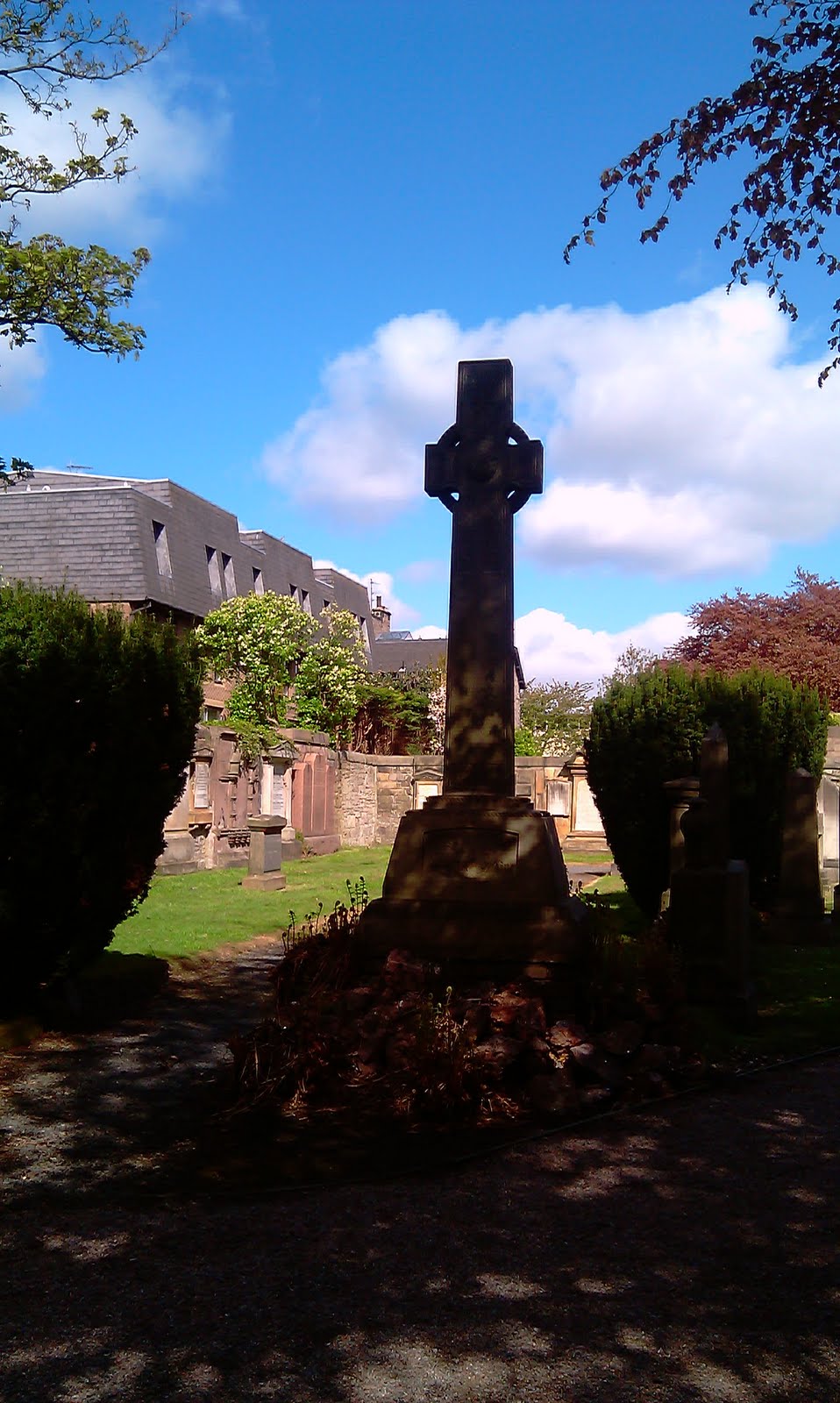 Yesterday I was able to visit the Edinburgh tomb of Lt. John Irving, RN, of the Franklin Expedition. As many people will be aware this tomb contains the remains of an officer of the Franklin Expedition buried on King William Island, which were discovered by Lt. Schwatka. On the basis of a medal found associated with the grave, the remains were identified as those of Lt Irving.
Were they really Irving's bones? Who knows, but it was a privilege for me to see this beautiful Celtic cross in the immaculately maintained Dean's Cemetery in Edinburgh.
I was struck not only by the dignity of the monument and its setting, but also by the aptness of its carving. Right down the shaft of the cross, it bears the following inscription:
In memory of Lt. John Irving, RN. HM Ship Terror. Born 1815. Died in King William's Land 1848-9. Her Majesty's Ships Erebus and Terror left England in May 1845 under command of Sir John Franklin KCB to explore a North West Passage to the Pacific. [Note the 'a', not 'the'] After wintering 1845-6 at Beechey Island they sailed south down Franklin's Strait and entered the NW Passage. Having been there beset with ice for two years Sir J Franklin and 8 other officers and 15 seamen having died the survivors 105 in number Lt. Irving being one landed on King William's Land and attempted to march to Canada but all died from cold and want of food. In 1879 Lt. Schwatka of the American searching expedition discovered Lt. Irving's grave. Through his kindness the remains of this brave and good officer were brought away and were deposited here on 7th January, 1881."
Below it is the quotation from the Bible - Romans 8:35 - "Who shall separate us from the love of Christ?" St. Paul went on to write: "Shall tribulation, or distress, or persecution, or famine, or nakedness, or danger, or sword?". The answer presumably was - no. In turn below that is the the famous wording from Horace, Odes III, 2, 13, which chillingly was used by Wilfred Owen for the title of of one of his most moving poems "Decorum est pro patria mori" - it is right to die for one's country. One wonders whether Owen was aware of this use of the quotation when he chose it as the title of his poem. And finally, there is an attractive bas relief showing the imaginary scene of the burial of Irving on King William Island. In the background can be seen the two ships Erebus and Terror. This does look rather similar to the bas relief on the Franklin Memorial in Waterloo Place, London, except without the more absurd fantasies of that one - no mountainous icebergs. And on Irving's tomb the mourners are shown holding nothing more unorthodox than a spade. Of course in reality I am not sure how much use a spade would have been for a gravedigger on King William Island - but at least the mourning sailors are not clutching bows and arrows as they appear to be in Waterloo Place! The bas relief is till in very good condition.
Of course when I spent my time before this cross I had two very different emotions. The historian in me mourned the loss of the young man buried below, and appreciated the quiet dignity of the tomb erected over him. But the archaeologist in me started to obsess about the potential for forensic evidence that was below my feet. Should we try to disinter these remains and see whether modern forensic research could find out more about this man and his unhappy death? Who knows?
Saturday, 3 April 2010
James Fitzjames book launch date

I'm very pleased to be able to say that my book 'James Fitzjames: the Mystery Man of the Franklin Expedition' will be launched with a Reception and Lecture to be held at Trinity House in the City of London from 6:00 pm to 9:30 on Tuesday 27th July, 2010.
The book is the first ever biography of James Fitzjames. On and off, I have spent a lot of time over the last two years reading, thinking, talking and writing about James Fitzjames and I feel I have got to know him quite well. He was a remarkable man with a rare combination of charm and intelligence and I hope the book is an appropriate memorial to him. As well as that, I hope that some readers at least find the account of his life and adventures exciting. And also, the book contains two significant exclusives. The first of these is who he was - his origins and family has always been unclear - and the second is the source of his influence. Neither of these have ever been known before and their revelation will cast significant new light on the Franklin Expedition.
Trinity House is a wonderful setting for this Reception and Lecture. One of the artefacts on display there is the sextant Admiral (then Captain) Collinson used during his search for Franklin (and Fitzjames of course). Collinson knew Fitzjames as they had both fought in the First Anglo-Chinese War.
I truly hope that this Reception is a worthy memorial to a brave man. If you would like to attend please let me know by contacting me through blogger or Facebook, where James Fitzjames has his own page.
Tuesday, 23 March 2010
An Excellent set of Daguerreotype images
I was very impressed with this set of images of the famous Franklin Expedition Daguerreotypes on the Scott Polar Research Institute's website:
http://www.spri.cam.ac.uk/library/pictures/catalogue/bnnpe1845-48/gallery/
The images of Couch and Stanley are especially interesting as they are of much better definition than most of the reproductions of their Daguerreotypes in circulation.
http://www.spri.cam.ac.uk/library/pictures/catalogue/bnnpe1845-48/gallery/
The images of Couch and Stanley are especially interesting as they are of much better definition than most of the reproductions of their Daguerreotypes in circulation.
Subscribe to:
Posts (Atom)
